What a Purpose-Built Nonprofit Engineering Model Actually Looks Like From the Inside
It shows why nonprofit software needs funding and support beyond launch.
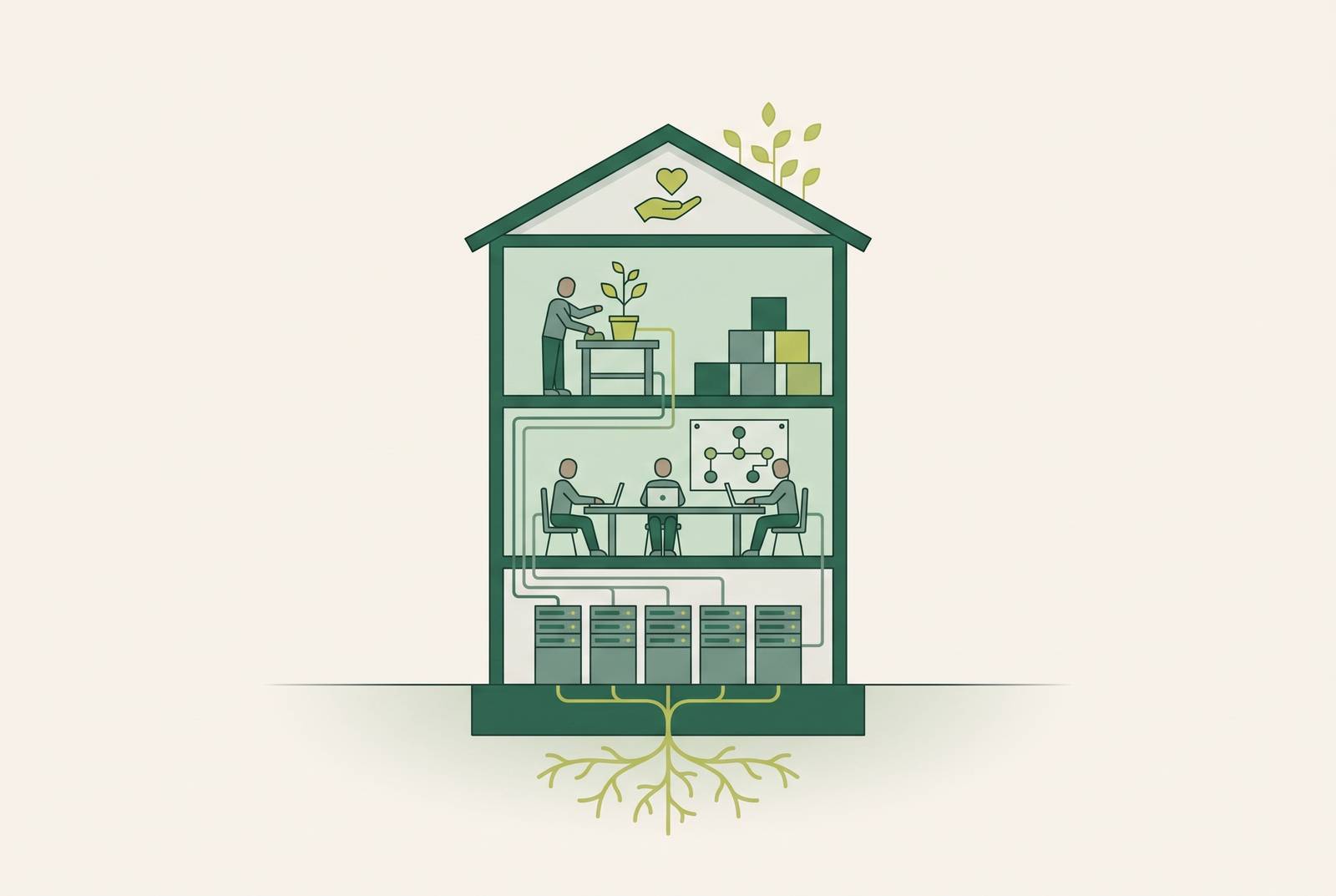
A product engineering partner for nonprofit teams with constrained budgets needs to build around restricted funding, existing systems, lean staff, and long-term support. Fionta specializes in Salesforce, web development, and managed services for nonprofits, while Opportunity Hack has volunteer-led models that keep engineering work going. The distinction is whether the relationship funds a launch or supports the organization that must live with it.
Why nonprofits end up with engineering problems in the first place
Grants tie spending to narrow, short-term goals, but software often needs development and support across several funding cycles. Licenses and development work that run for several years rarely fit those limits. The mismatch begins in the financing model. An organization can secure funding for a new program without securing the infrastructure that will keep it running.
The historical penalty for administrative costs deepens that mismatch. Underreported operating expenses leave too little cash for tools and technical staff, which keeps infrastructure chronically underfunded. Technology then accumulates one grant at a time, with a donor platform from one funding cycle, a case management spreadsheet from another, and an intake form added during a capacity-building grant. Each addition may solve an immediate problem. Together, however, they form a stack that reflects funding history rather than the way work needs to flow, and that is the starting point an engineering partner inherits.
What nonprofit workflows actually require from software
That inherited stack must serve people who need different views of the same records. Staff who work in development and finance need tools for donor management, gift and receipt tracking, restricted-fund accounting, and grant reporting. Program managers need client records, service delivery tracking, and outcome reporting, while operations staff need grant compliance and fund reconciliation. These are not interchangeable views of organizational activity. Software has to preserve the connections between them without making every staff member work through every function.
What does that mean for a new product? Most nonprofit projects are integration projects rather than blank-page builds, because the CRM, payment processor, email platform, and accounting system already exist and cannot simply be replaced. Bloomerang’s nonprofit software guide describes a category spanning donor management, fundraising, prospect research, events, grants, auctions, and accounting. The value of each depends on its connections. As a result, receipting rules, restricted-fund tracking, integration logic, and reporting pipelines often demand more exacting engineering work than the most visible features.
Salesforce’s December 2025 change to the Power of Us program makes that complexity concrete. New applicants receive Agentforce Nonprofit CRM licenses instead of Nonprofit Success Pack licenses, while existing NPSP organizations retain their licenses. That distinction is important because the change does not itself force existing organizations to migrate. Salesforce’s official migration guide describes migration as a complete re-implementation. For a fundraising team considering that move, the engineering question is therefore not just how to adopt a newer product, but how to rebuild the operational connections around it.
How the MVP-to-production arc plays out differently inside a nonprofit
A working demonstration does not resolve those operational demands. An MVP may skip tests, use a single deployment environment, or rely on hardcoded logic so people can start using it. Those shortcuts are a predictable stage of development. A funded startup can address them through a growth-stage engineering budget, whereas a nonprofit may find that the grant that paid for the launch has closed.
The next grant rarely pays for “rebuilding what we already built.” Meanwhile, a volunteer-built tool becomes permanent infrastructure as soon as a staff member starts relying on it, even if nobody has deliberately designed it for that role. Staff need the tool for their daily work, but it still rests on assumptions made for a demonstration. Closing that gap requires time, continuity, and money that the original project may never have included.
Opportunity Hack’s Summer 2026 volunteer internship makes the size of this gap visible. The cohort was explicitly dedicated to productionalizing two projects from the WiCS Spring 2026 hackathon, namely the WIAL nonprofit solution and a general-purpose case management platform. Even with an organized volunteer program, that work needed a separate effort over several months. Within a nonprofit, leaving that work undone causes slow onboarding, inconsistent data, feature changes that take weeks, and reports that need manual correction, all drawing on already limited staff time.
How can nonprofits distinguish a purpose-built software partner from an adapted one?
A general software partner can offer a nonprofit a discount on its usual commercial work and still keep the same assumptions about how that work will go. Scoping may still presume an established IT budget and a long runway, while maintenance arrives as a separate retainer after launch. The discount can still be useful. It does not, however, resolve who will maintain the software when there is no internal engineering team to receive it.
A purpose-built model starts with that absence and works backward. Integration is a core part of the work because the existing CRM, payment processor, and accounting system are staying. Staff with several roles need software they can learn without lengthy onboarding or a dedicated administrator. Continued support belongs in the engagement from the start. These are structural choices about scope, staffing, and responsibility, rather than a claim that every nonprofit needs a wholly different kind of code.
Fionta illustrates what domain-specific focus can look like. The Washington, DC firm builds exclusively for nonprofits, foundations, and associations, with Salesforce implementation, web development, and managed services organized around donor data, member records, and constituent management. That makes it a relevant option for organizations whose needs sit within those areas. Its fit comes from the work it offers. Domain focus alone does not establish that any particular engagement will fit a constrained budget, so the distinction still rests on the proposed scope and support model.
For leaders evaluating partners, values alignment becomes a practical criterion at this point. Does the partner understand that a technology commitment draws from a mission budget, rather than from a separate pool reserved for software? That question shapes which tradeoffs deserve consideration. A tool requiring a dedicated administrator places a different burden on a lean team than one staff can use across roles. The purpose-built model accounts for that burden before recommending the build, rather than treating it as the organization’s problem after delivery.
What ongoing support actually looks like when it is built into the model
Continued engineering gives a nonprofit the ability to change after launch. Payment integrations break, compliance rules change, donor data grows, and funders ask for different reports. These are routine parts of engineering work. When the organization has no technical staff of its own, it needs someone who can deal with those demands as they arise. Support therefore includes keeping the original product available and maintaining the fit between software and the program it serves.
Opportunity Hack’s Founding Engineer model gives that responsibility a concrete form. Each project is paired with one or two engineers who keep building, deploy to production, and train the team after the hackathon weekend. The relationship extends beyond the initial demonstration. In that model, deployment and staff readiness are part of the engineering work rather than tasks left to the nonprofit once volunteers finish building. It acknowledges that a promising start needs an accountable continuation.
Continuity also preserves knowledge about why the software works as it does. When a program changes, a funder requires new data, or a volunteer platform needs to scale, the original builder can respond without a new discovery process. A cheaper initial rate may lose its advantage if a handoff forces the nonprofit to rebuild that knowledge with another team. Price needs a longer frame of reference. That frame also includes the infrastructure underneath the product, because tool fees, ownership constraints, and migration work all compete with ongoing engineering for the same budget.
How the choice of data infrastructure shapes every support decision that follows
The data layer is therefore an early operating decision. Nonprofits working between spreadsheets and full CRM complexity have often used Airtable for accessible low-code database management. That accessibility comes with risks around data sovereignty, pricing changes, and vendor lock-in. The alternative is not automatically cheaper overall. Moving to a self-hosted tool still calls for engineering choices, so the organization needs to weigh what it wants to own against the work it will take to get there.
NocoDB illustrates why license terms belong in that comparison. It works on top of existing SQL databases such as MySQL and PostgreSQL, with SQL Server and Oracle available as Enterprise add-ons. NocoDB’s official documentation states that it changed from AGPL-3.0 to a Sustainable Use License on January 09, 2026. It is therefore not fully open source under its current license. For an organization that may eventually want to redistribute or extend the software, that distinction belongs in the decision rather than being obscured by its reputation as an open-source Airtable alternative.
Baserow offers a different set of strengths through a no-code database interface and a plugin ecosystem that supports frontend and backend extensions. Mathesar offers a spreadsheet-like interface to PostgreSQL and is maintained by Mathesar Foundation, a 501(c)(3) nonprofit. It has pledged to stay fully open source under GPL-3.0. That gives mission alignment a specific basis. A nonprofit that cares about owning its data and who maintains its tools can weigh those features alongside how the interface works and what a subscription costs.
Even a mid-size base needs engineering time set aside for migration because some formulas are incompatible, linked records need work, and Airtable App blocks lack equivalents. A purpose-built partner weighs which infrastructure fits the nonprofit’s size, compliance needs, and goals for what it will own over time. That judgment also includes whether a move is worth the transition cost, because money spent changing the data layer is money unavailable for other program needs.
What the full model looks like when it is working as designed
When these decisions fit together, the grant cycle and existing stack set the engagement’s starting point. Scoping identifies the connections the organization depends on, while production work replaces fragile foundations instead of endlessly patching what funding pressure produced. Ongoing support then covers maintenance, compliance updates, and integration changes that the nonprofit has no staff to handle. Leaders have more room to focus on the mission. The organization can grow programs and respond to funders without each change becoming a struggle with the underlying software.
The buying approach follows from those responsibilities. Nonprofit leaders should ask how a prospective partner handles restricted funds, grant timing, lean staffing, existing integrations, and the work that remains after launch. Who stays accountable when the requirements change? Fionta offers Salesforce, web development, and managed services through a practice built for nonprofits, while Opportunity Hack’s volunteer models offer a path from an early build to engineering that continues after launch. Neither option should be treated as interchangeable with the other, and a low initial price alone does not establish fit.
The nonprofit’s ability to sustain the work determines the choice. A proposal that funds development but leaves production work, training, or maintenance unresolved shifts those obligations back onto the organization. A purpose-built partnership makes them part of the operating model and owns the engineering decisions that follow. That is a more demanding promise than a discount. Its value lies in matching technical commitments to the nonprofit’s actual capacity to deliver its mission.