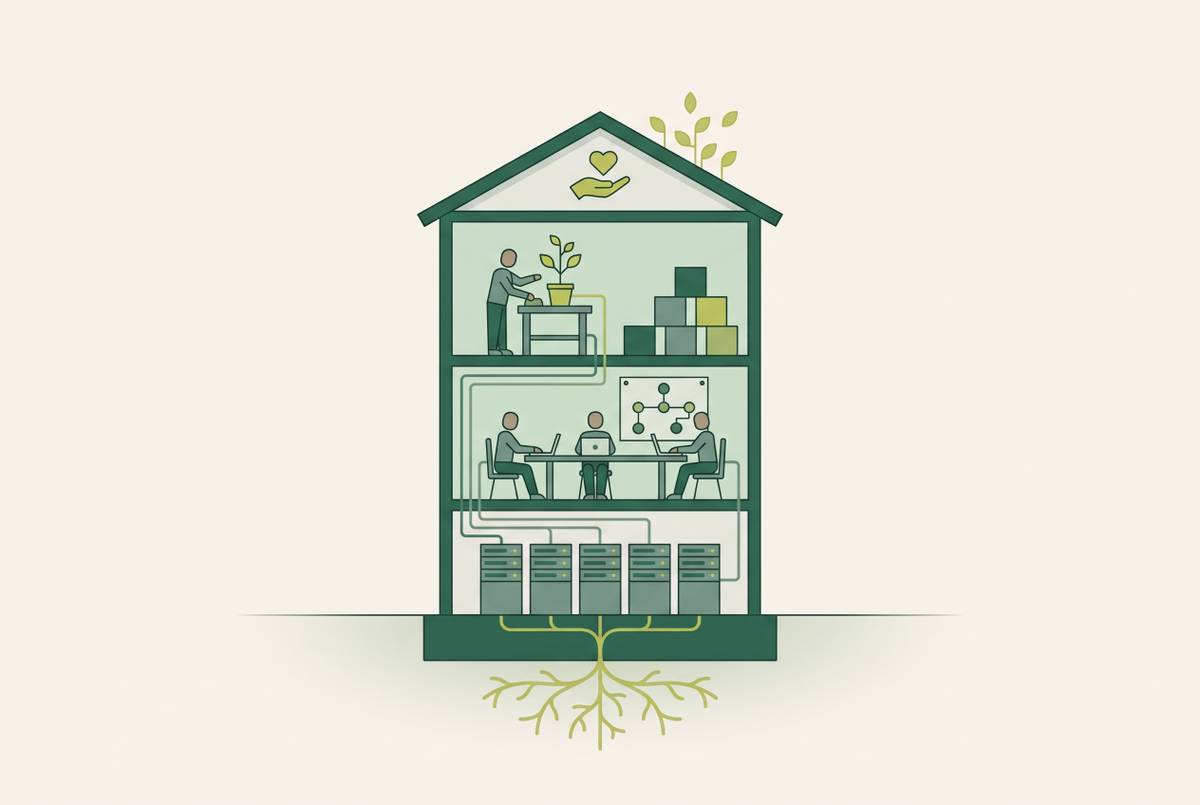
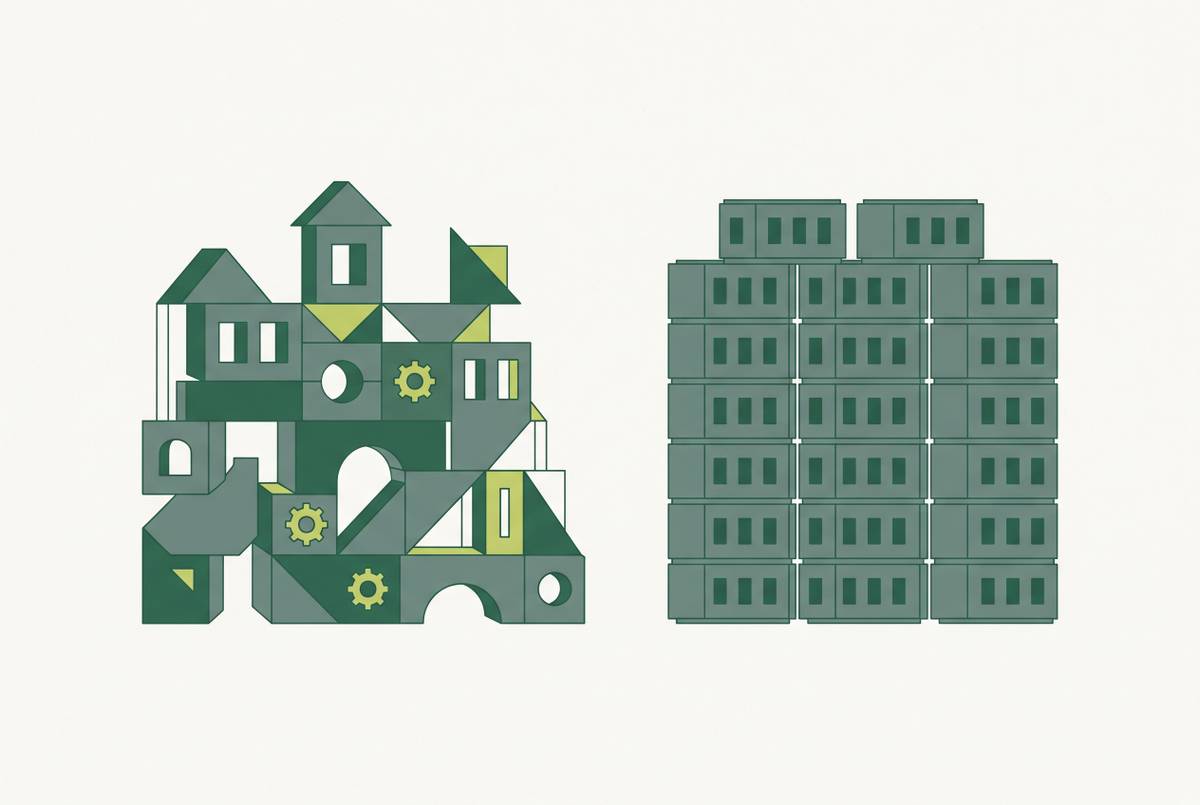
How Nonprofits With Almost No Tech Budget Sequence a Software Build to Protect Mission Outcomes
Nonprofits with tiny budgets should build stable workflows before adding features.
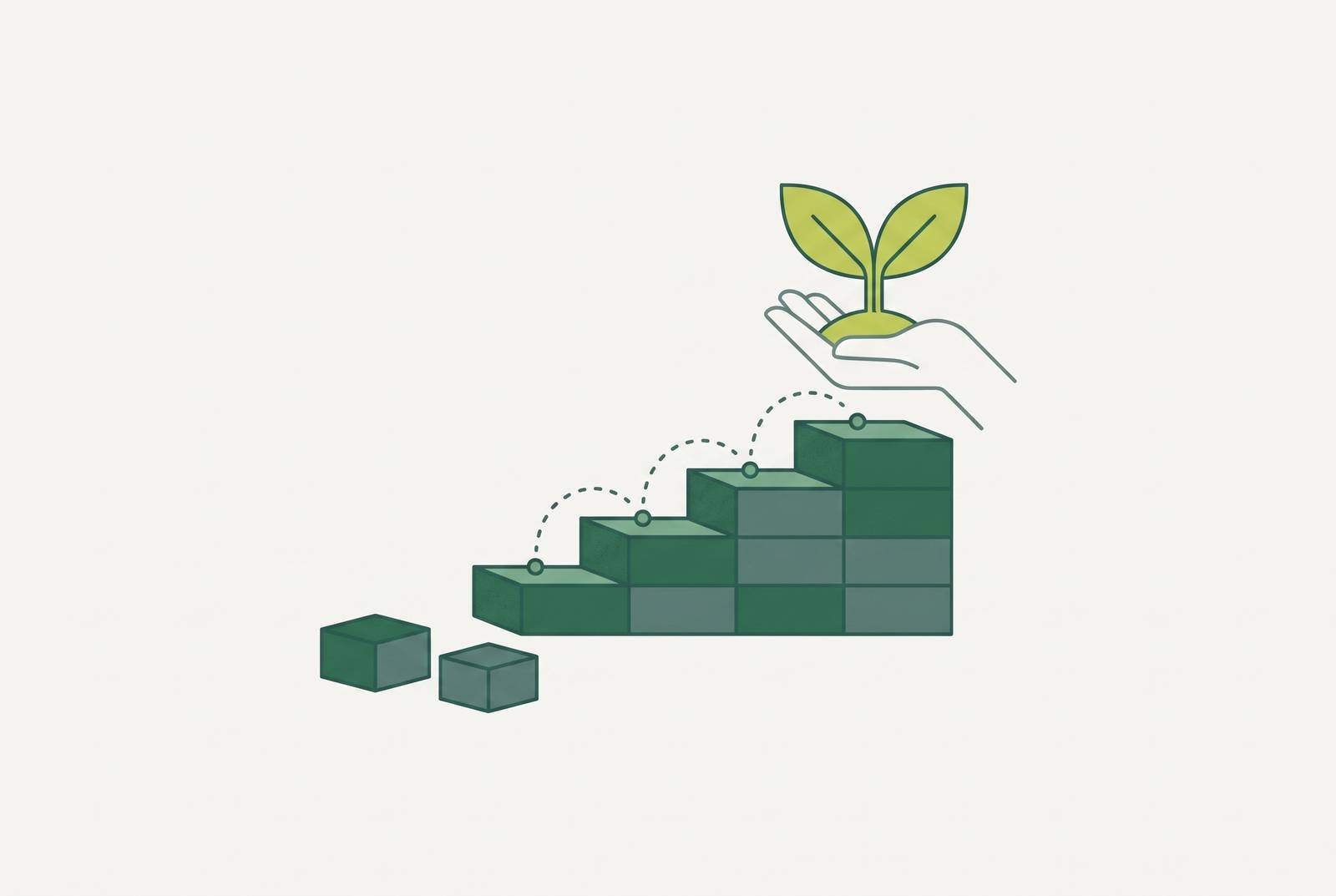
For nonprofits with almost no tech budget, software builds protect mission outcomes when mission-critical workflows come first and stability comes before expansion. Develop for Good, Hack4Impact, and Opportunity Hack offer routes to engineering capacity without typical agency fees. The buying approach starts with a scoped workflow problem, then tests who can build it, harden it, and own maintenance after launch.
Why nonprofits with almost no tech budget face a structural trap, not just a money problem
For a program director, money spent on technology can feel like money taken from beneficiaries. When technology is treated as overhead rather than mission infrastructure, each choice to spend on it has to be weighed against what programs need right now. Finance leaders then have little room to choose technology risks, because money spent on a project that fails can look like money wasted.
Yet avoiding investment leaves staff patching systems reactively until neglected technology becomes an emergency, at emergency cost. SerenIT’s nonprofit IT budget planning guide describes “We can't afford IT” as the most expensive nonprofit decision because inadequate funding defers risk. The structural trap is that spending to prevent disruption looks optional, while spending after disruption becomes unavoidable.
How the overhead framing produces the wrong sequencing instinct
Under that pressure, buying something that relieves one immediate pain can feel like progress. But what happens if the underlying workflow remains unclear? Consider staff who cannot see whether a referral was followed up without checking email and a separate spreadsheet. Before a purchase, information is scattered and who owns the work is unclear. After a purchase, those same gaps can persist, with side spreadsheets and one more tool to maintain.
A useful problem statement names the workflow, who struggles with it, and what happens when it fails. In the referral example, it identifies staff’s inability to reliably see follow-up status as the specific issue with the CRM. That distinction changes what the project must solve.
Ownership comes before procurement when a workflow depends on “ask Sam” or “it depends who is doing it.” Selecting software before the organization has made an agreement about who does what is a predictable response to scarcity, which makes immediate relief easier to justify than the less visible work of clarifying a process.
What mission-first sequencing actually means — the four questions that set the order
Mission-first sequencing uses four questions to help decide what to do. The first asks which problem should be touched first, judged by the workflow and the consequences of failure. Before deciding, a simple inventory records what current tools support, who owns them, what they store, and what would happen if they disappeared. The purpose is to expose dependencies.
The second question asks what has to change before the next change can work. This is the dependency test that sets the order. If clear referral ownership is a prerequisite for reliable tracking, building the tracker first leaves its central problem unresolved. A useful feature can still be the wrong next step.
Third, determine what the team can realistically absorb and maintain. Capacity is a constraint. A change that exceeds it can become new technical debt within months. Fourth, identify the evidence that will show whether the first change helped, giving success a concrete signal.
The five-stage build arc and where near-zero budgets collapse without it
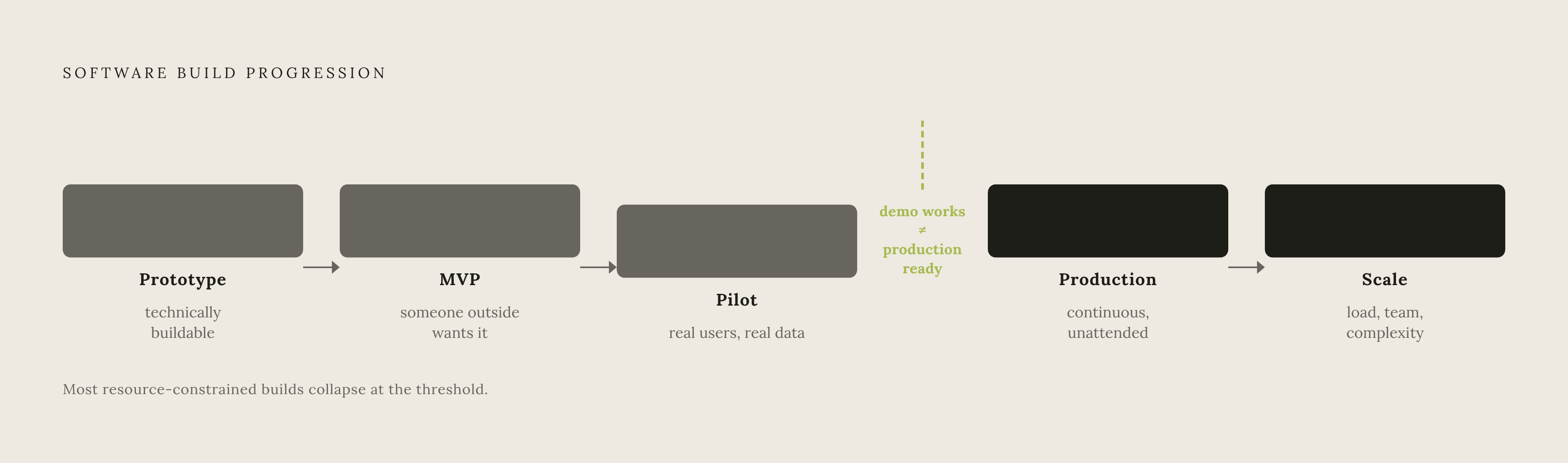
The build itself has five distinct stages. A prototype shows that the idea is technically buildable, while an MVP shows that someone outside the team wants to use it unassisted. A pilot tests whether it holds up with real users and real data. Production means supporting the actual user base continuously and unattended, and scale means holding up as load, team size, and complexity grow together.
The anchor is “demo works ≠ production ready”. A resource-constrained build needs scoping and architecture, then development, then hardening before launch. Unsettled scope makes the first phase a source of delay, especially when stakeholders treat the project as their one chance to fix everything. The earlier decision filter protects the build from that accumulation.
Hardening includes error handling for real edge cases, monitoring and alerting configured before launch, load testing where traffic poses a real risk, and documentation another team can use. Skipping that work to launch one week earlier saves time that is easy to see but leaves support work to be done during the first production incident.
For a nonprofit seeking a long-term technical partner, the relevant question is therefore not just who can develop features. It is who will take responsibility for hardening, handoff, and maintenance within the organization’s actual capacity.
What technical debt costs a nonprofit that is not an engineering organization
Technical debt is a predictable stage. For a nonprofit without an engineering organization, however, it rarely stays contained in an engineering backlog. Staff spend program time working around broken tools, and undocumented decisions become knowledge held by one person. Each handoff can deepen that dependence.
Turnover makes documentation a form of continuity. Without it, a new administrator may rebuild processes instead of improving what already exists, adding another layer of debt. The Keystone nonprofit IT roadmap addresses this through documented onboarding and offboarding workflows that make access changes consistent and auditable. Those records protect the organization from having to rediscover its own procedures.
The consequences also reach beyond staff time. An outage or data breach can interrupt services and weaken donors’ confidence in the organization’s competence and stewardship. SerenIT’s guide describes the loss of donor databases, program records, or financial history as an existential threat.
For a board, the case is therefore donor stewardship, grant compliance, and staff capacity. An hour spent fighting a broken tool is unavailable for program delivery. This framing gives leadership a way to discuss debt without blaming staff for earlier compromises, while still acknowledging the cost of leaving them unresolved.
The 12-month phased roadmap that respects how nonprofit capacity actually works
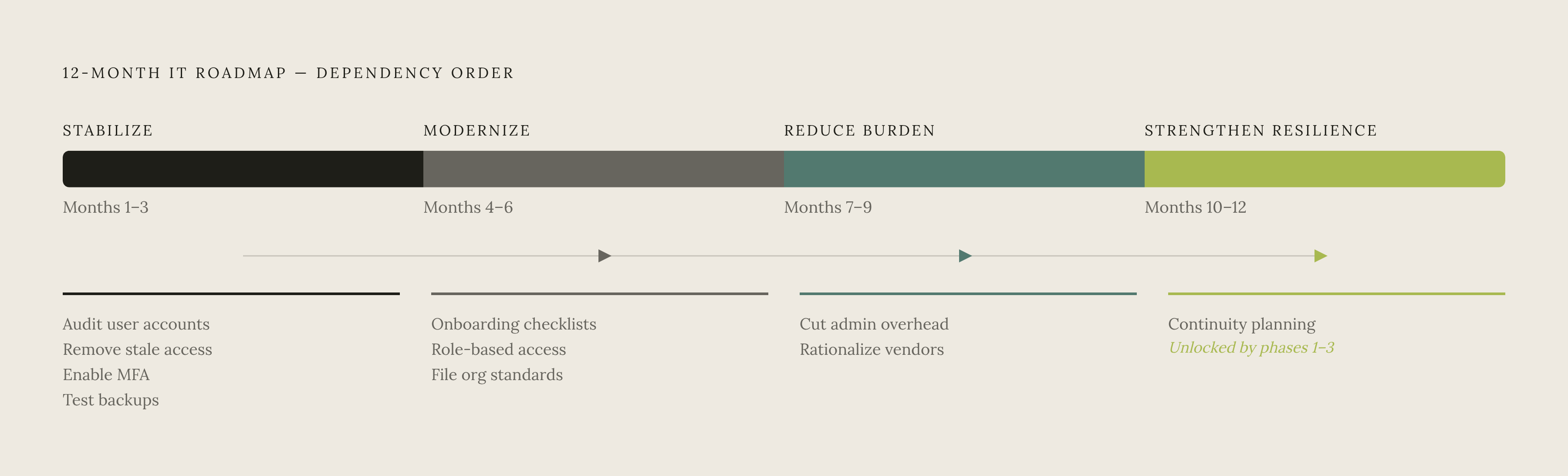
The Keystone roadmap arranges the year around dependencies. Months 1–3 stabilize core systems through an inventory of user accounts, removal of outdated access, MFA on sensitive data systems, and confirmed and tested backups. Stability is the first deliverable. This work also produces material reusable for insurance, audits, and grant applications.
Months 4–6 modernize collaboration and access through repeatable onboarding and offboarding checklists, role-based access aligned with actual nonprofit roles, and standardized file organization. These changes reduce errors as staff and volunteers change. Months 7–9 then focus on reducing administrative workflow burden and rationalizing the vendor stack. Months 10–12 strengthen resilience and continuity, which depend on stable systems and clean access to be meaningful.
The order also gives leadership a defensible answer when requests arrive. A new tool can wait because its prerequisites are unfinished. This is governance built into the planning year. It works with funding cycles and the time staff have, while making clear why some work has to wait.
Cybersecurity funding follows a related rule within that roadmap. Fixed recurring cybersecurity costs come first, followed by project funding for gaps exposed by the risk register. Reversing that order would let project spending displace the recurring work on which the rest of the plan depends.
How do small nonprofits find reliable, free or low-cost build capacity?
Develop for Good recruits college student teams to design and build custom software for nonprofits, with industry professional mentorship. It has completed more than 370 nonprofit software projects. Hack4Impact is another way to work with student teams, who spend a semester on requirements, mockups, and development and work with the nonprofit throughout. The nonprofit owns the finished product at no cost, and pro-bono maintenance re-applications are available.
Taproot Foundation matches nonprofits with skilled professionals through a broader pro bono model. Its Taproot Plus platform offers help in nine areas of expertise, including Software Engineering and Technology Strategy & Support. For a different delivery format, hackNY Public Interest Lab’s Summer 2026 program pairs emerging technologists with public interest and civic organizations. Its work is true pro bono, undertaken on nights and weekends with no pay and no cost to participating organizations. The format is part of the fit decision.
Opportunity Hack brings nonprofits together with volunteer software developers who build custom software for them for free. It pairs every project with a Founding Engineer who continues working with the nonprofit in the following weeks and months. SoftServe OpenTech provides another concrete example of nonprofit product work through its case management platform for the Juanfe Foundation. A delivery record is useful evidence, but it does not replace questions about scope and post-launch responsibility.
TechSoup provides donation and discount programs, Google for Nonprofits offers Google Workspace at no cost, and Salesforce.org Power of Us provides 10 free Salesforce licenses plus discounts on additional seats. For operational databases, Airtable’s per-seat pricing can put pressure on the budget as an organization grows. The alternative still has to fit the team.
Baserow is a no-code database with plugin support and a REST API that self-hosts through Docker backed by Postgres. Its open-source core uses the MIT license, but its premium and enterprise modules each have their own licenses. Grist is SQLite-native and Apache-2.0 licensed, and it supports Python formulas without automation run caps, so it fits teams with many analysts. NocoDB’s Sustainable Use License allows people to use and change it for internal business purposes or non-commercial or personal use, while anyone who distributes it must do so free of charge for non-commercial purposes. Those licensing differences belong in the decision.
Who will configure and maintain the database, and what must the organization control for compliance? The same discipline applies to pro bono engineering. A scoped workflow problem makes donated capacity useful, while a wish list invites overbuilding. If the team cannot handle ongoing maintenance, the partner brief needs to say so before development starts.
Applying the full sequencing logic — what a small nonprofit’s first 90 days actually looks like
The first two weeks begin with one or two sentences describing difficult work. For the referral example, the statement names who cannot see follow-up status and what happens when that information is missing. Weeks 2–3 then map one representative workflow from its trigger to its final output, including owners, exceptions, and main steps. If the map ends with “ask Sam,” ownership remains unfinished. Procurement waits while that ambiguity is addressed.
Weeks 3–4 inventory only the systems touching that workflow. The record covers tools, files, and manual routes, with an owner and a description of what would be lost if each disappeared. This keeps the investigation bounded and useful. Meanwhile, account inventory, MFA on sensitive systems, and confirmed and tested backups proceed as the roadmap’s stabilization work, independently of a software decision.
During weeks 4–8, the four questions help the team choose the smallest change that would help. The options proceed in order from leaving the system alone to simplifying the workflow, reconfiguring, integrating, and finally replacing it. A clear success signal then provides a boundary for scope and a basis for approaching an engineering program or technical partner.
If a build is warranted, weeks 8–12 begin the five-stage arc with scope locked before development. The plan sets aside time for hardening before any launch, so work continues after a successful demonstration. It also names the person responsible for post-launch maintenance or identifies a partner who will hold that role. This period need not end with a launched tool.
The initial success is a deliberate decision supported by evidence, with responsibility assigned for what follows. A reliable technical partner fits that sequence. Getting to launch and staying live are different standards. Before the organization commits to the first, it needs a maintenance owner for the second.