How Nonprofits Sequence Engineering Access When Consulting Firm Rates Are Structurally Out of Reach
A staged path from free tools to pro bono to paid engineering.

Nonprofits that cannot afford typical engineering rates can build access in stages, using low-cost tools, structured pro bono programs, and then narrowly scoped paid work. The right product engineering partner for a budget-constrained nonprofit must fit its staff capacity, funding constraints, and need for ongoing maintenance.
Why engineering rates are structurally out of reach for most nonprofits
Engineering costs depend on scope, complexity, and specialization, so nonprofit pricing does not necessarily make an engagement affordable. Varsity Technologies describes a cost environment in which an infrastructure overhaul demands far more than advisory work. The gap begins before a proposal arrives. Nonprofits have long treated technology as overhead rather than infrastructure they need to run, spending less on it than businesses typically do even when their work depends on it.
Unsteady funding makes that mismatch harder to fix. CEP’s State of Nonprofits 2026 reports cuts in foundation and federal funding that affect organizations already unsure of what funding they can count on. When staff are cut and plans are put on hold, organizations have less to spend on technology and fewer people to manage it. Sequencing engineering access is therefore a rational response to a structural condition.
What sequencing actually means in practice
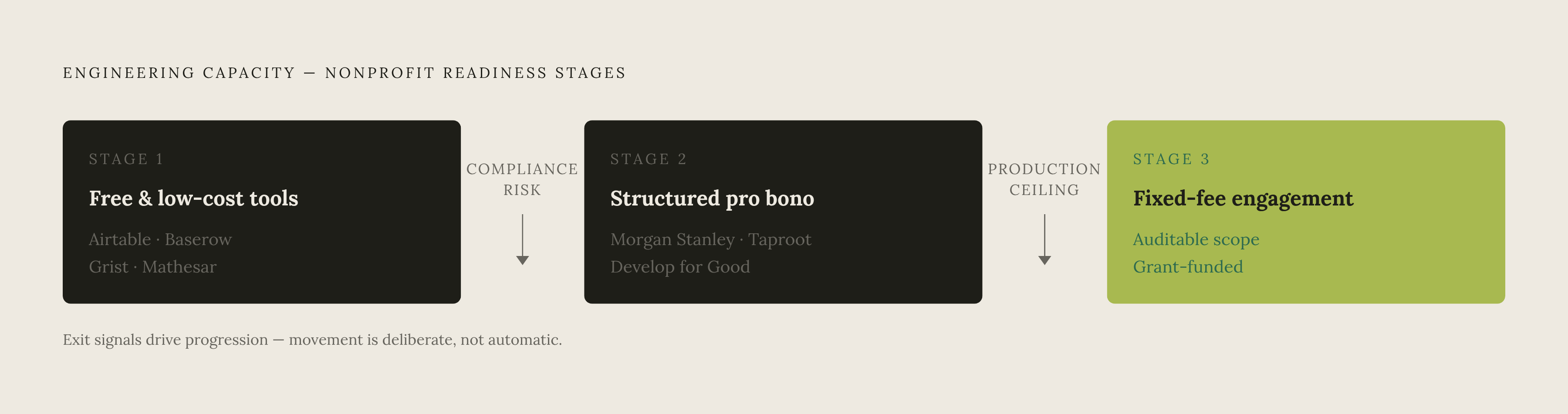
Sequencing means matching the kind of technical help an organization uses to what it can absorb. The first phase uses free and low-cost tools to prove that operations work. Structured pro bono work can help when those tools reach their limits, while paid work on a specific need becomes possible when grants or unrestricted funds can cover a job with clear limits. Money is only one condition for moving forward. A team also needs the ability to operate a tool, manage a volunteer relationship, or define and implement paid work.
Timing introduces risks in both directions. Hiring consultants before operations are stable enough to explain can waste money, while keeping volunteer-built systems past their useful life creates brittleness and data risk. The organization needs to assess whether it is ready for the next stage. Some nonprofits take a different path through the three phases, but knowing the sequence helps leaders see when to move on before an urgent failure forces their hand.
Stage one: free and low-cost tooling as operational infrastructure
Spreadsheet-database hybrids let nonprofits establish working operations before an engineering engagement is realistic. Airtable is a familiar place to start, though per-seat pricing and record caps can limit what an organization can do as it grows. The team needs to establish whether a workflow functions and whether staff can operate it consistently. Building something more sophisticated before that is clear may commit scarce resources to an unsettled process.
Even at this early stage, nonprofits need to think about who owns their data. Baserow offers a self-hosted approach in which data lives on the organization’s own infrastructure and can migrate on its own terms. That control comes with an operating requirement. The nonprofit must be able to manage the infrastructure, rather than treating self-hosting as a cost-free substitute for a hosted service. A SaaS choice instead exposes the organization to vendor lock-in and export risk if pricing changes.
Other open-source options make the choice broader than a single product. Grist offers a free community edition with spreadsheet logic, while Teable uses PostgreSQL underneath and offers a free tier. Mathesar provides a spreadsheet-like interface directly on an existing Postgres database and is maintained by a 501(c)(3) nonprofit. These options suit different needs. The exit signal is a specific workflow that the current setup can no longer safely or reliably support, whether because of compliance-heavy data, complex integrations, or production reliability requirements.
Stage two: structured pro bono programs and the staff capacity they actually require
Structured programs offer engineering access that an organization could not otherwise purchase. Morgan Stanley’s Tech Change Makers pairs technologists with nonprofits for a 6–8 month engagement to design and build websites, applications, and workflow tools. Develop for Good recruits product, engineering, and design students to build digital products for nonprofits. These programs offer more than informal troubleshooting. They create a route from a known operational need to a piece of software built with outside skills.
Taproot Plus has a free online platform where nonprofits can get real-time expert advice or work on multi-week projects. The Salesforce Accelerator combines grants with coaching and substantial pro bono support for nonprofits building their own AI and agentic solutions. The form of help varies considerably. A nonprofit needs to put different kinds of work into a short exchange with an expert and a longer product build.
Someone must brief volunteers, explain the organization’s context, attend meetings, answer questions, and implement recommendations. Staff need time set aside each week for that work. An organization with too little bandwidth may be unable to benefit even when the technical help costs nothing, because the missing input is internal ownership.
This complicates the assumption that pro bono work automatically builds lasting capacity. A volunteer initiative and a nonprofit’s operational needs do not necessarily align, and a useful deliverable still needs follow-through. Before applying, a nonprofit should check that it can do its part throughout the work with volunteers. Does a staff member have the time and authority to own the work?
What happens when an MVP or volunteer-built tool hits a production ceiling
A working prototype answers a different question from a production system. The prototype shows that an approach can work, while the production system must remain reliable when real users depend on it. Shortcuts are often rational at the beginning. Hard-coded configuration, thin test coverage, and missing observability can be acceptable trade-offs when the alternative is spending months engineering code that may be discarded. Technical debt does not make the original decision wrong.
The risk changes when nobody knows how much debt exists or what it threatens. If staff cannot see what is happening in production, they cannot judge whether the system remains dependable. AI-generated and vibe-coded products can reach this point too. A product built primarily in Lovable, Bolt.new, or a similar environment may work in development while concealing fragile data-model choices, missing security layers, or absent test coverage. Those weaknesses may become visible only under real user load.
The transition has concrete signals a team can recognize. A tool fails or behaves unpredictably with real users, or compliance and security requirements exceed what the current stack can support. Required integrations may need custom backend logic, while a departed volunteer team may leave nobody responsible for the codebase. These operational needs define the point at which paid engineering can become necessary, and they provide the bounded problems around which an affordable engagement can be scoped.
Stage three: entering the paid market with a scoped, fixed-fee engagement
When grants or unrestricted funds become available, the recommended entry into paid engineering is the smallest fixed-fee engagement that solves a specific problem. An open-ended relationship is not the starting point. With a narrow scope, the nonprofit can pin down what will change, what it will take to put those changes in place, and where the work ends before agreeing to a larger rebuild. This is especially useful after a prototype has revealed both a valuable workflow and a reliability problem.
ThinkShout has built platforms for the Southern Poverty Law Center and Facing History and Ourselves, which shows it has done this work for nonprofits. Its rates and engagement sizes are comparable to those of other established mission-driven firms, so mission alignment should not be confused with unusually low pricing. A relevant portfolio answers only one question. The organization still needs to establish whether a proposed engagement fits its budget and operating conditions.
For a nonprofit buyer, understanding those conditions means more than offering a discount. A good partner understands how boards approve work, what grant compliance allows, and what people inside the organization who lack technical skills need. It also accounts for what happens after delivery. A mission-aligned product engineering partner that rebuilds on solid foundations and stays through maintenance addresses the risk of paying for software and then having no technical owner when it breaks.
Clear pricing helps a nonprofit tell whether it can manage the work it is agreeing to pay for. Scope, deliverables, timeline, decision points, and implementation responsibilities should be unmistakably clear in the proposal, reducing exposure to scope creep and unbudgeted overage. What single flow or system failure is costing the organization users, funding, or staff time, and can it be addressed within a fixed, auditable scope before a larger rebuild begins?
New funding channels that are expanding access at every stage of the sequence
New philanthropic and corporate initiatives are creating additional routes into technical work. The Ford Foundation’s announcement of Humanity AI names ten founding partners, including MacArthur, Ford, Omidyar Network, Mellon, Packard, Doris Duke, Lumina, Kapor, Mozilla, and Siegel Family Endowment. The initiative is dedicated to making AI deliver for people and communities. It is a new source of funding, though access is not guaranteed. OpenAI’s People-First AI Fund also provides substantial support for U.S. nonprofits.
These initiatives can change where an organization enters the sequence. Grant-funded access to more sophisticated support may let a prepared nonprofit skip or compress the earliest phase of low-cost tools. A grant does not itself supply the staff member who explains operations, resolves decisions, or takes responsibility for implementation.
The nonprofit software market is expected to grow, which points toward more competition among vendors, more nonprofit pricing tiers, and more self-hosted options. That direction may widen the range of affordable choices over time. It does not promise that engineering access will become straightforward for every organization. Organizations still compete for grants and pro bono slots, and those that know what they need and are ready to take on help can make better use of them.
How can small nonprofits find the right engineering support next?
Can the team operate its current data infrastructure? Does the organization control its data, and is the workflow stable enough to explain to someone outside the team? If those conditions hold, the next question is more specific. Which workflow is now straining the setup, and what specific limit on its safe operation creates a defined need for engineering?
Can a staff member own an outside engagement? For a 6–8 month program such as Tech Change Makers, that means sustained responsibility. If that capacity is missing, applying before the team has it could waste the chance to get help. If it is present, the organization can judge whether volunteer expertise matches the work required. The relevant measure is not simply the amount of free help offered, but the work the team can turn into lasting capability.
Is there a problem with clear limits that is worth paying to solve? A broken flow, a compliance gap, or a codebase without an owner can provide the basis for a fixed-fee scope. The organization also needs to commit to implementation. Comparing the cost of delay, confusion, or internal stalemate with the proposed fee helps make that decision concrete. A constrained budget does not make postponement costless.
Finally, who owns the system after the build? For an organization moving into production, a partner that stays through maintenance provides a genuine operational advantage by reducing firefighting and letting leadership focus on mission delivery and growth. That responsibility belongs in the partner decision from the outset. The sequence exists whether or not an organization maps it. Mapping its readiness, trade-offs, and exit signals is what turns the next technology decision from a reaction into a strategy.