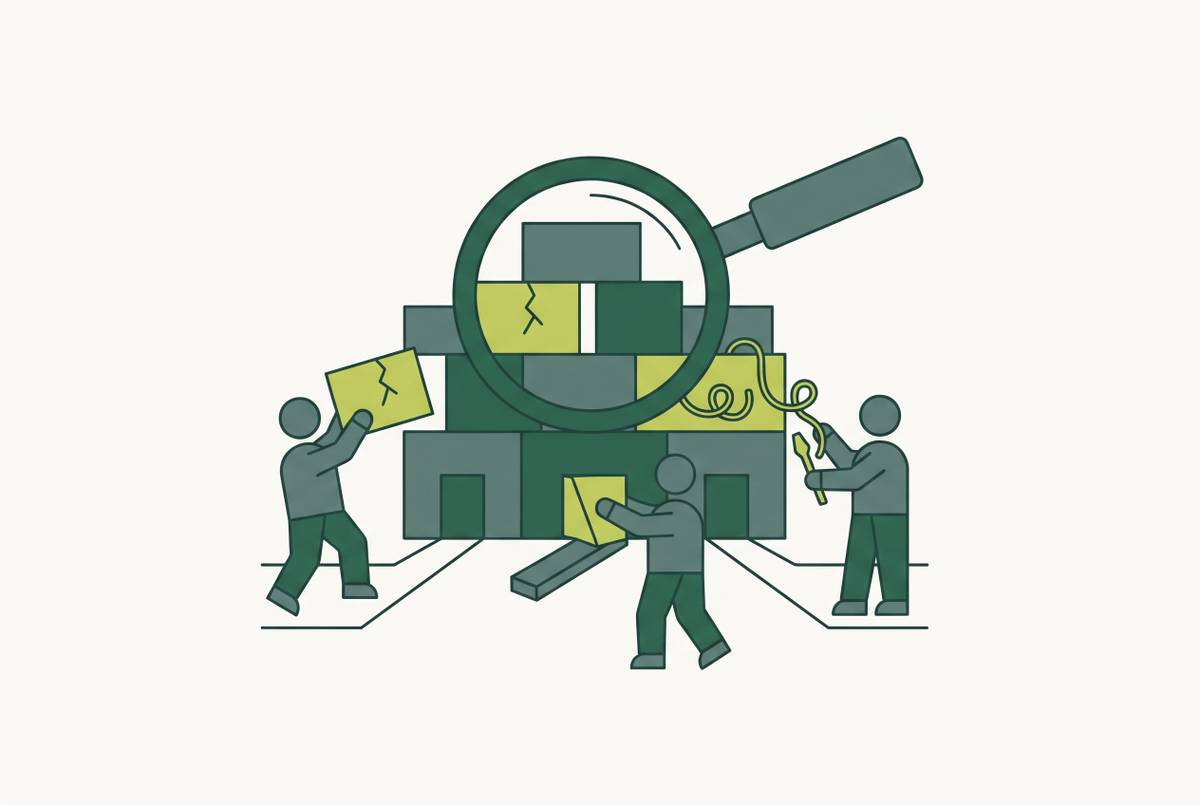
Dependency Rot in Early-Stage Products After Rapid MVP Builds
A pre-hire audit separates urgent security risk from debt that can wait.
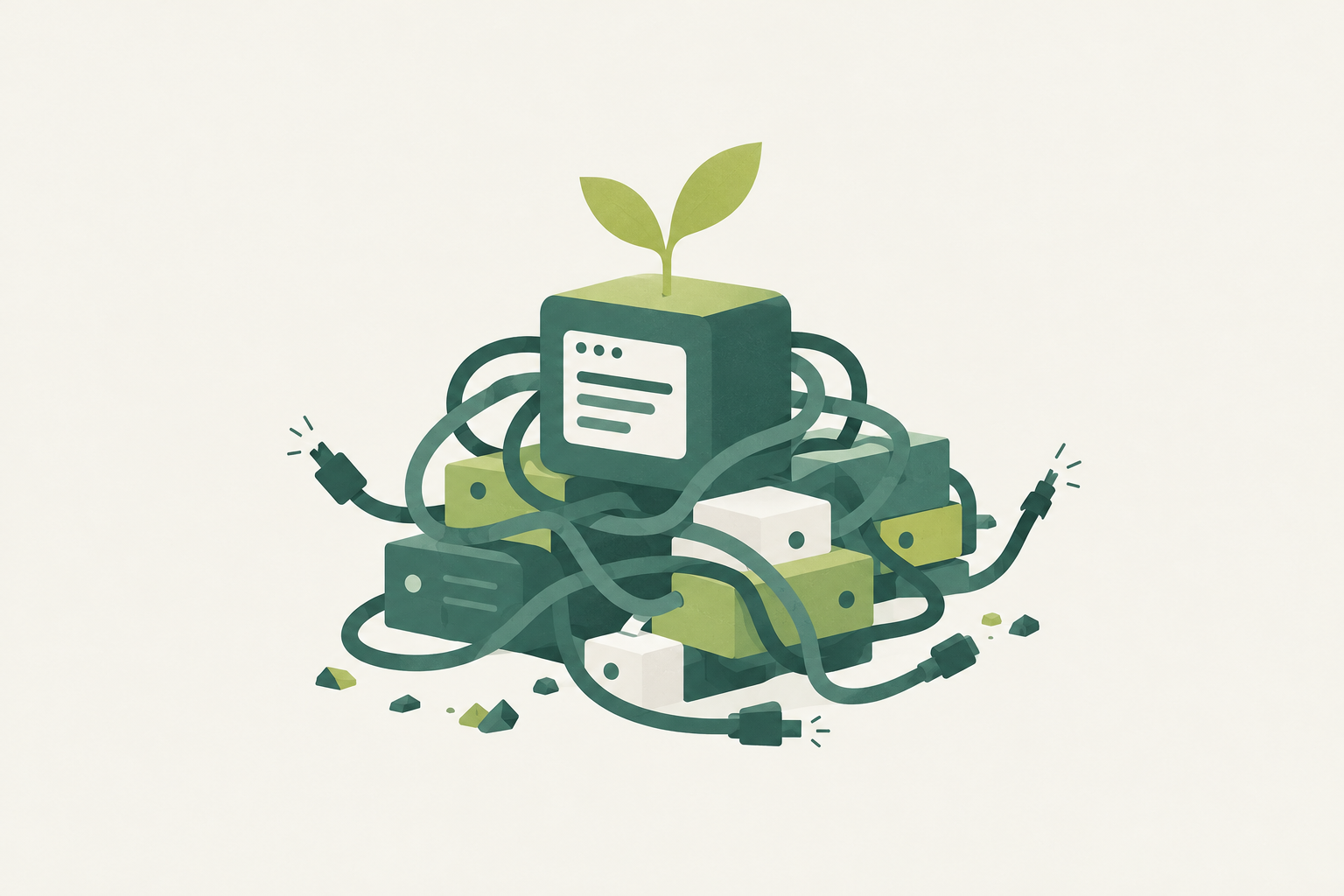
Dependency rot after a rapid MVP build is an ownership problem involving a maintenance backlog. Before hiring an engineering partner, a technical debt assessment should map unexplained packages and integrations, test whether the team understands critical flows, and establish who controls production accounts and intellectual property. The aim is to separate debt that can wait from security exposure and blocked upgrades that demand action now.
Why dependency rot is structurally different from other technical debt
A deliberate shortcut has someone who remembers taking it. That person can explain why a test was deferred or a data model simplified, even if the decision later proves costly. Dependency rot often has no such witness. A package arrived through generated code, brought other packages with it, and remained without anyone taking responsibility for its purpose or upkeep.
McKelvey names three forms of AI technical debt, which are comprehension debt, drift debt, and dependency debt. Comprehension debt means nobody can explain the code, and drift means more than one pattern does the same job. Dependency rot joins those problems at the software supply chain. Unlike a slow query, an unexplained library need not make the product visibly worse to widen its attack surface. Who defends against a risk nobody remembers introducing?
How the AI-assisted MVP pipeline produces dependency rot by design
Building an AI-assisted MVP rewards getting something to work now. A generation step reaches for a library that solves the immediate problem, without a coherent view of what the lockfile already contains. Later sessions can add packages without taking out the ones chosen earlier. Transitive dependencies, the packages those libraries need to work, add to the tree beyond the tools the team knows.
That is a structural incentive. MVP teams have always accepted shortcuts, but generated code increases the speed and opacity with which dependencies accumulate. The interface works, so the build appears complete even though its supporting parts remain unexplained. McKelvey’s lockfile method exposes that gap by marking every package nobody can justify out loud.
No-code tools move the same problem into another layer. A stack assembled from Airtable, Make, and third-party API integrations can work without anyone holding a complete map of its connections. In both cases, assembling a working product is easier than understanding everything it now depends on.
How dependency rot hides between launch and the moment it fails
During validation, a product with very few users may offer little warning that its foundations are fragile. A vulnerable package can show no signs of trouble until someone uses the vulnerable path. Meanwhile, what the team has built looks finished, and the team turns to marketing, leaving it unchecked. There is no ledger of shortcuts because nobody experienced those choices as shortcuts.
A small change breaks an unrelated feature, a fix takes several attempts, or the team avoids touching components that “work.” New features then deepen the coupling to the original dependency tree, making removal harder. Even performance trouble can arrive late, when a query that seemed harmless under light use becomes disruptive under much greater concurrency.
Security exposure is harder to read from product behavior. An outdated library with known vulnerabilities need not slow the interface or generate customer complaints. A launch that goes well also gives no proof that anyone has checked what the application can reach. MoltBook shows how sharply that gap can become public.
What failure actually looks like when dependency rot surfaces at scale
MoltBook launched as an AI-agent social platform whose founder had not written a single line of its code. In January–February 2026, security researchers found that its production database was completely exposed three days after launch. An independent ethical hacker was the first to make the flaw public, and Wiz Research looked into it more deeply in a separate investigation. Millions of API tokens, tens of thousands of email addresses, and plaintext credentials in private messages were accessible through the app’s own normal API.
The failure did not require a clever intrusion. An unreviewed application surface exposed data that the generated system could reach. This demonstrates the broader failure of comprehension that allows dependency risks and other security gaps to remain unexamined.
Lovable provides a separate example at platform scale. In April 2026, a Broken Object Level Authorization flaw was publicly disclosed affecting every project created before November 2025, after it was first reported through HackerOne on March 3, 2026. Together, the cases challenge the assumption that a working generated application has a reviewed security boundary.
Why the engineering contractor handoff is a second, compounding source of rot
A handoff can remove the knowledge needed to untangle an already fragile system. The incoming team opens code it did not write, while the person who understood the original choices has left. Two gaps now reinforce each other. The dependencies are unexplained, and the context that might explain them is unavailable.
A nonprofit built around Airtable makes this especially concrete. A contractor may assemble donor tracking, program management, automations, linked tables, and formulas into a working operational system. After the contractor leaves, staff can still use it without understanding how its parts fit together. The organization now has a system that works but lacks the knowledge to change it safely.
Production accounts should belong to the startup from day one, including hosting, the domain, source repository, analytics, payment provider, and email services. Contracts also need clear assignment clauses for proprietary algorithms, custom-trained model weights, and specialized datasets made as part of the work. Access, intellectual property, and technical understanding are distinct ownership questions.
How Airtable dependency concentrates this risk for nonprofits and early-stage teams
Airtable can concentrate operational dependency because the platform holds more than records. Formulas, linked tables, and automations encode how an organization works. When only a departed contractor understands those relationships, staff depend both on the platform and on missing expertise. It becomes hard to change either without affecting the other.
Bending Spoons announced a definitive agreement to acquire Airtable on August 4, 2026. The announcement included no new pricing model, shutdown plan, or deadline forcing customers to leave. Bending Spoons stated its commitment to investing in Airtable for the long run. Those limits deserve as much attention as the acquisition itself.
There is still a risk to weigh. Bending Spoons has a documented history of large workforce reductions after acquisitions and a sharp focus on efficiency. That history is a planning consideration for Airtable. For a small organization, the concern is how pricing pressure and acquisition uncertainty interact with automations it cannot readily explain or move.
What migration out of platform dependency actually requires
Leaving Airtable involves more than exporting the visible records. Formulas need rewriting for the destination, linked records require manual rebuilding in most tools, and Airtable App blocks have no open-source equivalent. A mid-size base with a few dozen tables and automations requires roughly one to several weeks of migration work. This is not a weekend patch.
The organization faces the harder task of establishing whether it knows what it is moving. If the original contractor has left, a functioning automation may have no available explanation of its purpose or dependencies. Moving just the tables leaves those questions unanswered. A dependency audit before migration therefore needs to map every automation, formula, linked field, and integration.
That map gives the migration its actual scope. It distinguishes records that can transfer from behavior that needs rebuilding and relationships that need careful reconstruction. For a nonprofit or founder, migration is the re-engineering of a core operational system, with the planning discipline that a production rebuild requires.
Airtable alternatives that resolve the ownership and dependency problems
NocoDB addresses ownership by connecting a spreadsheet-to-database interface to existing databases, including PostgreSQL, MySQL, SQLite, and Microsoft SQL Server. Its AGPL-3.0 license and the many people who use it in the community matter to teams that want an open-source path. The storage distinction is central. Teams can work on databases they already own rather than placing data residency under the interface vendor’s control.
Baserow puts more emphasis on an accessible migration path. Its built-in Airtable import uses a base’s public share link to transfer tables, fields, records, linked records, attachments, and grid views. Paid plans start at $10/user/month. Teable also offers a built-in importer that moves a whole Airtable base in a few steps. These importers reduce transfer work, but they do not erase the need to assess formulas, automations, and integrations.
Mathesar offers a spreadsheet-like interface for viewing, editing, and querying PostgreSQL data directly. Mathesar Foundation, a 501(c)(3) nonprofit, maintains the project under GPL-3.0 and commits it to staying open source. That governance is a strong differentiator for mission-driven organizations with data-residency requirements. Can the organization keep data in a portable format, self-host if needed, and rely on an active open-source community not controlled by a single commercial acquirer?
When intentional debt is correct and when the window to address it closes
Doing too much refactoring before product-market fit can waste money when little is available. A consciously chosen shortcut may be the right way to test a hypothesis, especially when user counts and risk are low. Some systems will be discarded entirely. Building them for an imagined future can be as costly as neglecting systems that have already proved useful.
The timing changes once validation gives way to growth. When there is a measurable drop in feature velocity, it makes sense to target refactoring at the cause, but when the system’s structure makes features impossible to ship, a rebuild may be justified. The difficulty is noticing the transition soon enough. Teams can cross that threshold before they recognize how tightly new work has become coupled to the original build.
Dependency rot narrows the opportunity for gradual repair. A vulnerable package gives no advance notice of exploitation, and upstream deprecation can disrupt a production deploy without changes to the team’s own code. User count alone tells a team little about when to act. Debt that slows feature delivery can often be dealt with bit by bit, but security exposure or a blocked critical upgrade path calls for action right away.
How do you audit your codebase before bringing on an outside development team?
A first audit can begin at the next standup. The explain test asks whether anyone can walk through authentication end to end on a whiteboard without opening the repository. If not, comprehension debt comes before any confident cleanup plan. Next, the pattern count checks how many distinct ways the code makes an HTTP call or formats a date. More than two indicates drift and a place to look for hidden dependencies.
The lockfile read then makes dependency debt concrete. Every package nobody can justify out loud belongs in the assessment. For an Airtable or no-code stack, the equivalent is a map of automations, formula dependencies, linked table relationships, and third-party integrations. The first priorities are authentication, billing, and data writes, with cosmetic or low-risk areas coming later.
The assessment must also establish what a safe handoff lacks. Its scope includes the highest-risk refactors, secrets in a managed vault, CI/CD wiring, critical-path tests, observability, and formal account and credential transfer. An audit makes the next decision possible, whether that is refactoring, rebuilding, or engaging a partner. It does not complete the repair. AI-assisted cleanup still requires a human comprehension step, or it merely adds another layer of unexplained decisions.
What the MVP-to-production transition requires from a technical partner
A technical partner’s first obligation is to understand the existing system before changing it. An assessment before signing should cover architecture, dependency purpose, critical flows, security exposure, upgrade constraints, tests, observability, account control, and intellectual property. That scope separates a production transition from a superficial code review. It also gives the founder a basis for judging whether the proposed work prioritizes risk.
The relationship must survive the initial cleanup. A partner suited to this transition can audit and triage what exists, establish sound foundations, and remain involved through growth when another dependency fails. Accounts and credentials belong with the client, and the system must remain understandable to the organization that operates it.
For nonprofits, that includes respecting limited budgets, mission-first decisions, and staff with multiple roles. A replacement system that only its new builder understands recreates the handoff problem in another form. Selecting a partner therefore requires considering alignment alongside price. Who will help the organization own and operate the product after the urgent rebuild is over?