When Third-Party APIs Become Single Points of Failure
Stacking five reliable services drops your uptime below what most assume.
Third-party APIs don't fail gracefully. They fail mathematically, and most builders never do the arithmetic before it's too late. A single external dependency, even a well-run one, lowers the ceiling on what you can promise your own users, and that ceiling drops faster than intuition suggests.
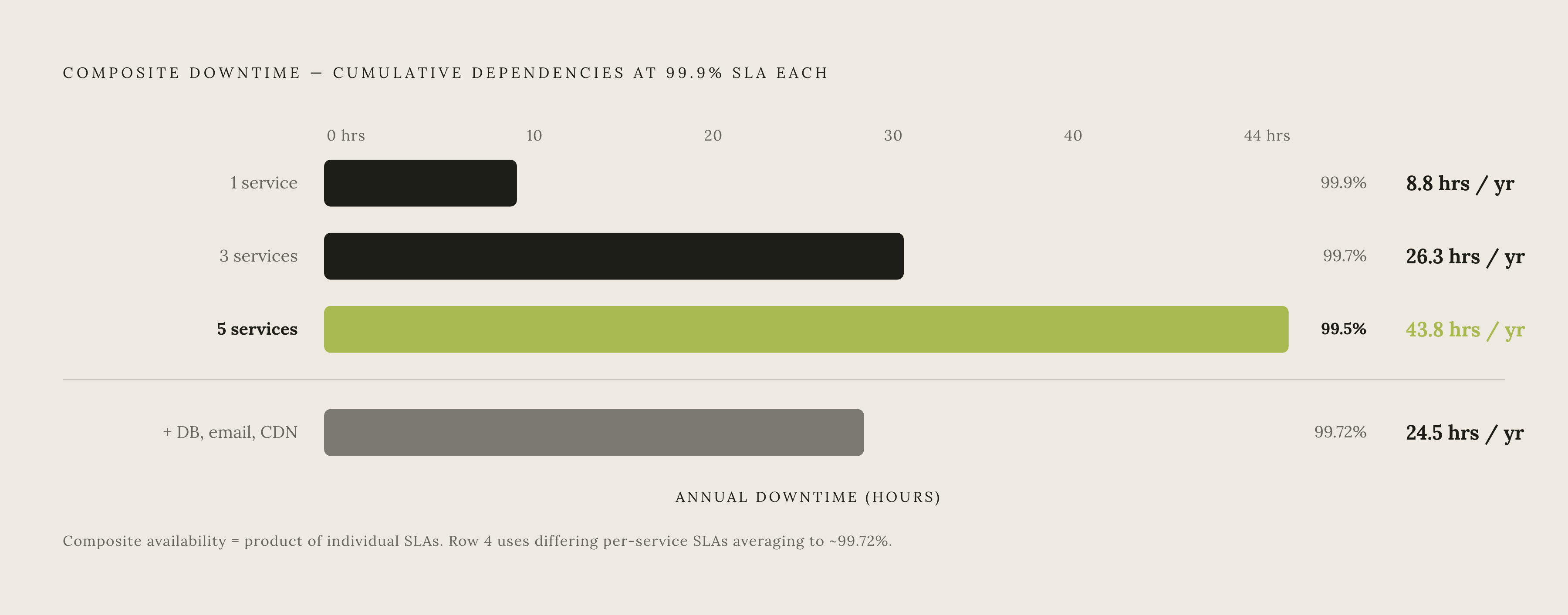
Start with the math, because it's genuinely simple. Composite availability isn't an average of your dependencies. It's a product. If you call five services, each humming along at 99.9% uptime, you might assume your system runs at something close to 99.9% too. But if you multiply five instances of 99.9% uptime together, the result lands noticeably lower, not something close to 99.9%. Multiply five instances of 99.9% uptime together and the result lands noticeably lower. That gap, roughly half a percent, sounds trivial until you convert it into hours: over forty extra hours of downtime a year, just from stacking dependencies that each look excellent in isolation.
Now extend the stack the way a real product does. Add a database, an email service, a CDN. A stack that includes those dependencies can produce a composite figure around 99.72%, which works out to roughly 24.5 hours of potential downtime annually. Nobody wrote a bug to cause that. Nobody misconfigured anything. It's just what happens when independent probabilities multiply. Most builders never run this calculation. They inherit somebody else's SLA, glance at the "99.9%" on a pricing page, and quietly treat it as their own uptime promise to customers, without ever checking what happens when it's stacked five, six, seven times deep.
And here's where the SLA language becomes a trap. Most of those documents are financial guarantees, not technical ones. When a provider misses its target, the response is a credit, not restored uptime. A vendor whose monthly fee is modest but who causes a multi-hour outage during a peak sales window can cost a business many multiples of that fee in lost revenue, and the credit that appears on next month's invoice won't cover the difference. The math above isn't a warning dressed up as prose. It's just what composite reliability looks like once you write it down.
Where the AI API category sits on the reliability curve right now
AI inference APIs sit meaningfully below the reliability tier that mature SaaS categories have settled into, and the gap is measurable rather than anecdotal. Per The Neural Base's April 2026 comparison of major AI API providers, OpenAI's API carries a 99.9% SLA and Anthropic's Claude API runs at 99.5%. As of that comparison, the SLAs across major AI API providers sit meaningfully below what mature infrastructure categories have achieved, reflecting where the entire category currently stands rather than a shortcoming of any one provider. That's not a knock on any one of them. It's a statement about where the entire category currently stands.
Stated SLAs are the ceiling providers promise. Measured reality is what actually happened, and the two don't always match. A Nordic APIs report tracking over 215 services between October 2025 and February 2026 found OpenAI running at roughly 99.76% overall, with components tied to one interface dipping to around 98.89% during one stretch. Anthropic also logged incidents across that same window. Compare that to Stripe, whose status page was essentially blank across the same months, or Linear, which posted 99.96%. Payments infrastructure and developer tooling have had a decade or more to mature. AI inference is scaling and shipping new models simultaneously, so the infrastructure underneath it is younger and under more volatile load than what a company like Stripe runs.
That's not a temporary dip, either. The Uptrends State of API Reliability 2025 report, built from 2 billion monitoring checks across more than 400 companies, found average API uptime falling from 99.66% to 99.46% between Q1 2024 and Q1 2025. That's a 60% increase in downtime year-over-year, across APIs broadly, not AI specifically, but it puts the AI category's numbers in context: the floor for third-party reliability is moving in the wrong direction industry-wide, and AI inference is starting from a lower baseline than most.
What does this mean if a critical user flow, an onboarding step, a checkout confirmation, a support chatbot, calls out to one of these providers? It means accepting a reliability floor that isn't yours to control, before a single line of internal infrastructure code even runs.
How outages actually cascade: five incidents that show the failure modes
Reliability numbers are one thing. Watching how an outage actually spreads is another, and five recent incidents show five distinct failure patterns.
Concentration risk: on November 18, 2025, a bug in how Cloudflare's bot management feature files were generated caused a significant service failure. That disrupted Cloudflare's API and degraded dashboard access, rippling into thousands of downstream services, including portions of X, OpenAI, and even Downdetector, the site people use to check if something else is down. When a small number of providers carry a disproportionate share of internet traffic, one internal fault propagates to services that have no business relationship with each other and no idea they share an exposure.
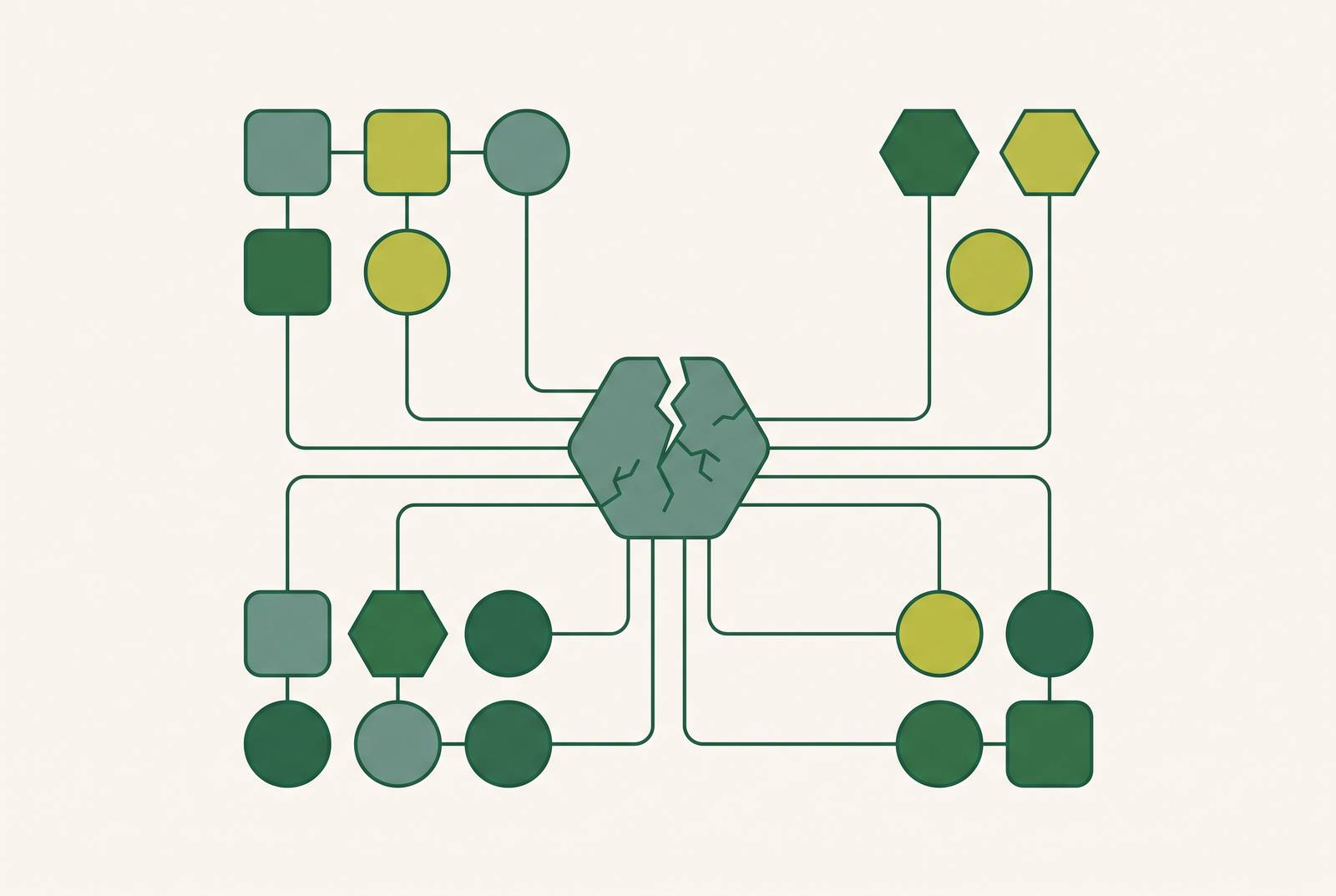
Implicit shared dependency: in June 2025, Google Cloud pushed a quota policy update containing blank fields. It replicated globally within seconds and triggered a software defect in Google Cloud's Service Control layer, causing many Google APIs to return errors for roughly three hours. Cloudflare, seemingly unrelated, lost several of its own services in the same window because Workers KV depended on third-party storage that failed during that event. Access, Gateway, WARP, Workers AI, Turnstile, and other Cloudflare services were impaired for 2 hours and 28 minutes. Two vendors, bought specifically to create redundancy, turned out not to be two independent failure domains at all.
Regional cascade: October 2025 brought a DNS race condition inside AWS's DynamoDB that cascaded across the us-east-1 region into 141 affected services. The incident lasted more than 14 hours. ChatGPT, Snapchat, Slack, and Atlassian all experienced disruption. Businesses that depended on affected platforms for a material share of their orders had no recourse for the duration.
Simultaneous multi-vendor failure: on September 3, 2026, four leading AI services had trouble within the same few hours. OpenAI, Anthropic, and xAI all confirmed service interruptions affecting ChatGPT, Claude, and Grok, and third-party monitoring showed elevated failure rates for Google's Gemini API around the same time. Nobody has confirmed a shared root cause. What matters is the overlap: enterprises that had built in a second or third AI provider specifically as a fallback found that all their fallbacks were degraded at once.
Operational blast radius: July 2024's CrowdStrike incident wasn't an API failure in the strict sense, it was a faulty software update, but it belongs in this list because of scale. Aviation, retail, banking, and healthcare all took hits. Airlines canceled flights. Retailers, including Dick's Sporting Goods, closed some store locations. One vendor, sitting well upstream of the visible product, created a blast radius most of its indirect users never saw coming.
Five incidents, five different mechanisms. But the thread running through all of them is the same: the dependency that causes the damage is rarely the one sitting in the architecture diagram. The dependency that causes the damage is rarely the one sitting in the architecture diagram; it is the one underneath it.
Why MVPs are particularly exposed to this structural risk
Every shortcut taken to hit a launch date is a decision that almost never gets revisited once the product starts working. That mechanism explains why MVPs carry more of this risk than mature products do, not less.
If the backend is really a stack of third-party shortcuts, or an AI product is mostly a wrapper around someone else's model or platform, the hard part isn't owned. The hard part is rented rather than owned. That's fine at the MVP stage, since speed helps a product launch faster while nobody's using it yet, and ownership can wait. But the arrangement rarely gets flagged for revisit later, because revisiting a working integration doesn't feel urgent until the day it breaks.
And it breaks more than founders expect. Per the State of the API report, 52% of developers faced production environments crashing in 2024 because an external vendor pushed an unannounced breaking change, making it a majority experience rather than a rare one. That's not a tail event affecting a unlucky few. That's a majority experience.
There's a second layer here, sometimes called environmental or dependency debt. A third-party library or framework a team depends on can go end-of-life, get repriced, or get acquired, all for reasons entirely outside the team's control, and any one of those can strand an integration overnight. Specialized API startups compound the risk further: per 2025 data, 18% of them pivot or shut down within 24 months, leaving their users stranded.
What does stranding actually cost? After Builder.ai collapsed, NexGen Manufacturing spent $315,000 migrating 40 AI workflows to a new platform. The migration ate three months of engineering time, and several customer-facing AI features were degraded or simply unavailable during that stretch.
The fix isn't "use fewer APIs." Fewer dependencies doesn't solve a structural problem, it just shrinks the surface area slightly. The real fix is keeping integrations behind abstraction layers, so swapping a provider doesn't mean rebuilding the product from the inside out. That's the kind of decision that's cheap when a system is first being designed and expensive, sometimes $315,000-expensive, when it's retrofitted after the fact. Getting a product to launch and keeping it alive under real user load are two different engineering standards, and the codebase that won the first battle is rarely built to win the second.
Why nonprofits face a heightened version of the same exposure
Nonprofits lean on third-party SaaS and no-code tools for a good reason: they usually can't afford to build custom systems from scratch. But that same cost efficiency is exactly what concentrates their operational risk into platforms they have no control over. The tool that made a small team's work possible is also the tool holding all their exposure.
Moving to a SaaS application does not transfer the security burden entirely to the vendor. Moving to a SaaS application does not transfer the security burden entirely to the vendor. Organizations that assume it does end up with a false sense of security. A CRM vendor's security posture is, functionally, the nonprofit's own security posture, whether anyone signed up for that framing or not.
Regulatory pressure is tightening around this too. Organizations that receive or pass through funds from a national government. government funds are now subject to reasonable cybersecurity measures under guidance the Office of Management and Budget released under Section 200.303 of 2 CFR, without a single prescribed framework to follow, which leaves a lot of interpretation up to organizations that may not have a security team at all.
The financial stakes are already visible. Per StratusLive's donor data security guide, nonprofit data breaches cost the sector more than $49.5 million in settlements in 2023 alone, with additional state-level penalties continuing into 2025 and 2026. And here's a gap that compounds the exposure further: 76% of nonprofits lack an AI governance policy, per that same source, leaving donor data exposed to whatever new risk a generative AI tool happens to introduce.
Third-party code isn't a peripheral risk category here, it's the dominant one. The 2026 State of Software Security Report attributes 66% of the most dangerous, longest-lived security debt to third-party code, and finds that 62% of applications carry vulnerabilities that originated in open-source libraries. Even a resourced vendor isn't immune: in November 2025, OpenAI disclosed that its third-party analytics provider, Mixpanel, suffered unauthorized access that let attackers export an analytics dataset. If that can happen downstream of OpenAI, it can happen downstream of a modestly priced monthly CRM plugin.
None of this lands the same way on a nonprofit as it does on a funded startup. Limited budgets, staff wearing four job titles at once, mission-first decision-making under real time pressure: when a critical platform changes its terms or its pricing overnight, there's often no engineering capacity sitting around to respond quickly.
What the Airtable acquisition illustrates about platform dependency risk at scale
Airtable shows what this risk looks like once a dependency gets big enough to be load-bearing for an entire category of organizations. Nonprofits, startups, and small engineering teams have used Airtable for years as a no-code or low-code backend. For a lot of them, Airtable isn't a tool layered on top of the product. It functions as the product's data layer.
On August 4, 2026, a company (NASDAQ: BSP) announced a definitive agreement to acquire Airtable in an all-cash deal, valuing the company at an enterprise value of $1.285 billion. Factoring in Airtable's existing net cash position, that implies an equity value of roughly $2.25 billion.
At the height of the pandemic-era software boom, Airtable was valued at over $11 billion, backed by more than $1.4 billion raised from investors including Salesforce Ventures and T. Rowe Price. At the height of the pandemic-era software boom, Airtable was valued at over $11 billion, backed by more than $1.4 billion raised from investors including Salesforce Ventures and T. Rowe Price. The acquisition price represents a steep discount from that peak, even though Airtable reports annual recurring revenue growing more than 20% year-over-year, the metric Bending Spoons is pointing to as justification for the deal.
Why should an Airtable-dependent organization care who's buying, specifically? Because the acquirer's track record is the closest thing available to a preview of what comes next. Per Noloco's analysis of the deal, Bending Spoons' past acquisitions have tended to be followed by leaner teams and higher prices. Evernote's Pro plan jumped from $37 a year to $250 a year after its 2022 acquisition by the company. WeTransfer lost 75% of its staff within two months of being acquired in 2024. Bending Spoons has been explicit about its strategy: acquire established software trading at a discount to its private valuation. That's a business logic built around cost structure, not necessarily product investment.
For teams that built critical workflows on top of Airtable, that means pricing, feature availability, and support levels are all now uncertain in ways they weren't a year ago. Functionally, these organizations face the same migration risk NexGen Manufacturing faced after Builder.ai collapsed, the difference being they've been handed some advance warning instead of a sudden shutdown. No-code and low-code platforms earn their popularity by lowering the barrier to building something real without a full engineering team. That same accessibility is what lets a platform quietly become deeply embedded in daily operations, long before anyone stops to ask what migrating off it would actually cost.
What architectural decisions actually reduce this risk
Resilience against API failure is something designed into a system, not bolted onto it after an outage teaches a hard lesson. That distinction matters, because it changes when the work needs to happen: at the architecture stage, not the incident postmortem.
The clearest structural defense is the abstraction layer. Keep third-party integrations behind an adapter interface, so swapping a provider means changing the adapter, not rebuilding the product. That's the decision that's cheap to make early and expensive to retrofit later, and it directly addresses both the 52% of developers who've dealt with an unannounced breaking change and the $315,000 migration bill NexGen Manufacturing paid when Builder.ai went under.
Are two vendors actually two independent failure domains, before trusting any redundancy setup? The June 2025 Google Cloud and Cloudflare incident answers that clearly. The June 2025 Google Cloud and Cloudflare incident showed that the two vendors were not two independent failure domains. Before treating a second provider as a real fallback, check whether both vendors share a cloud region, a DNS provider, a CDN, or an identity layer. Buying from two companies doesn't automatically buy independence if they converge on the same infrastructure somewhere downstream.
If a choice has to be made between the two, graceful degradation keeps the product usable during a failure, while prevention alone leaves it broken. The right design question isn't only "how do I stop this API from going down?" It's "what does this feature do when the API isn't there?" The September 3, 2026 outage that hit OpenAI, Anthropic, and xAI within the same few hours proves the point: even a genuine multi-provider strategy can leave a product with zero fallback if every provider degrades at once.
Retry logic, circuit breakers, and fallback responses handle the more common case, the transient failure. Most incidents resolve within a fairly short window, and these patterns exist specifically to absorb that kind of blip without the user ever noticing. They're also exactly the patterns that get skipped first when a team is racing toward a launch deadline.
And none of it works without monitoring the dependency itself as seriously as internal infrastructure gets monitored. Uptrends' 2025 analysis of 2 billion monitoring checks suggests most organizations don't track third-party API uptime with anywhere near the rigor they apply to their own systems. A failure that isn't being watched for is a failure that can't be responded to quickly.
There's a simple test that cuts through a lot of this: for any given third-party dependency, would a price change, an acquisition, or a shutdown force a core user flow to be rebuilt? If yes, that dependency needs either an abstraction layer or a documented migration plan. And when it comes to SLAs specifically, the productive question was never "what's their uptime guarantee?" It's "what's the fallback when they miss it?" SLA language should shape architectural decisions upfront. It shouldn't be mistaken for one.
How a long-term engineering partner changes the calculus on API dependency
The failure here usually isn't that a founder picked the wrong API provider. It's that the architectural decisions determining how resilient a system will be get made under launch-deadline pressure and then never get revisited, sometimes for years, sometimes until an outage forces the issue. A partner who stays engaged after launch is the mechanism by which those decisions actually get a second look.
Technical debt sitting inside API integrations isn't a sign that something went wrong early on. It's a predictable stage every product built under time pressure passes through. What matters is when it gets addressed. The moment real users start depending on a product is exactly the moment a single broken flow, a stalled checkout, a chatbot that goes silent mid-conversation, can cost a customer permanently, not just for an afternoon.
Getting to launch and staying live under real load are different engineering standards, and few teams have the bandwidth to hold both at once while also shipping new features. That's the gap a long-term partner fills: not by picking better APIs at the start, but by being present when the shortcut that got a product out the door needs to become a wall that can actually hold weight.
Sources
- API Reliability Report 2026: Uptime Patterns Across 215+ Services | Nordic APIs |
- Overlapping AI Outages Expose an Enterprise Resilience Gap
- The State of API Reliability 2025
- Google Cloud, Cloudflare struck by widespread outages | TechTarget
- Mastering Third-Party API Integration Challenges: A Developer’s Guide for 2026 - API Pilot
- investors.bendingspoons.com
- noloco.io