SaaS Sprawl and the Hidden Cost of Integration Debt
Hidden integration costs compound faster than companies can track them.
The average company now runs 118 SaaS apps, up 11% year over year according to BetterCloud's State of SaaS Report. That number reverses two years of consolidation, and it's the visible part of a much bigger story. The app count on the invoice is not the real cost. It's what happens in the space between those apps, where nobody's watching.
Zylo's 2026 SaaS Management Index breaks the scale down further: mid-market companies (501 to 2,500 employees) run an average of 263 applications, large enterprises (2,501 to 5,000) run 408, and mega-enterprises above 5,000 employees run 696. Yet portfolio count barely moved, dipping just 0.07% year over year per Zylo. So the problem has shifted. Companies aren't adding tools anymore so much as they're stuck paying for the ones already sitting in the stack.
None of this happens because someone made one bad call. Sprawl is widely understood as the predictable outcome of dozens of rational decisions made in isolation from each other: marketing picks a tool, sales picks a different one, ops picks a third, and each choice made sense on its own. Sprawl is reactive. Consolidation is strategic. A real plan connecting the apps matters more than their number, especially as costs start stacking up.
What integration debt is and why it is harder to see than wasted licenses
Integration debt is the accumulated middleware, custom scripts, and duplicate data stores a company builds just to keep disconnected systems talking to each other. It's not the same as technical debt, though the two feed off one another. Technical debt is shortcuts in code and architecture. Integration debt is specifically the connective tissue cost, the price of keeping a fragmented SaaS stack in conversation with itself.
It's also not the same as license waste. An unused license is money sitting idle, a line item finance can spot and cut. A broken integration is different: it affects operations every single day, quietly, in ways that don't show up on an invoice.
Most of this debt starts with an assumption: connect later. Teams buy tools expecting the integration work to happen downstream, once things settle down. Later rarely arrives. Instead the business ends up running on manual workarounds that were supposed to be temporary and never left.
Shopify's guide identifies three distinct forms this sprawl takes. Shadow IT covers unsanctioned tools running outside IT's visibility. Functional overlap is what happens when multiple departments buy tools that do the same job, independently, without knowing the other exists. And integration debt itself is the buildup of middleware, brittle scripts, duplicate data stores, and custom glue code that holds it all together.
Sprawl is the condition. Integration debt is the compounding cost that condition produces, and it's the debt, not the sprawl, that actually slows growth down.
How integration debt shows up in daily operations before it shows up in the budget
Picture the reporting cascade at a mid-sized company. Marketing tracks campaign performance in one platform. Operations tracks resource allocation in another. Finance tracks budget in a third. Pulling all of that together for one meeting means manual reconciliation, and manual reconciliation means errors, delays, and someone's Tuesday afternoon disappearing into spreadsheets.
Wellingtone's State of Project Management 2025 found 42% of organizations spend one or more full days manually collating project reports. Think about what that means for a quarterly planning meeting: executives are making real decisions based on data assembled by hand, from systems that don't talk to each other, and that data is often incomplete before anyone opens the deck.
This tends to be most visible around the $20M ARR mark. According to TekStack, B2B companies at that scale often discover the exact stack that got them there is now working against them: data silos, integration debt, rising operational costs. The quoting tool doesn't talk to the CRM. Finance reconciles renewals in a spreadsheet nobody outside finance has ever seen. Support runs in one system while the actual customer record lives somewhere else entirely. Ask "where are we with this account?" and the honest answer requires four open tabs and a prayer.
The result, per TekStack, is that nobody has a full view of anything. The business runs on partial information and the manual labor required to bridge it, not on systems that actually connect. TekStack also notes that when systems don't connect, the majority of the data a company generates goes unused for analytics entirely. It's generated, it's stored, and it never gets touched.
Every new integration point is also a new potential failure point. As the stack grows, so does the surface area for something to break. None of this appears as a line item. It appears as a slower decision here, a missed signal there, and engineering time that was supposed to go toward new work getting pulled into keeping the glue from cracking.
Shadow IT and the governance gap that lets integration debt accumulate undetected
55% of enterprise apps qualify as shadow IT, software employees use without IT ever knowing it exists. That's not a rounding error. That's more than half the stack running outside anyone's field of view.
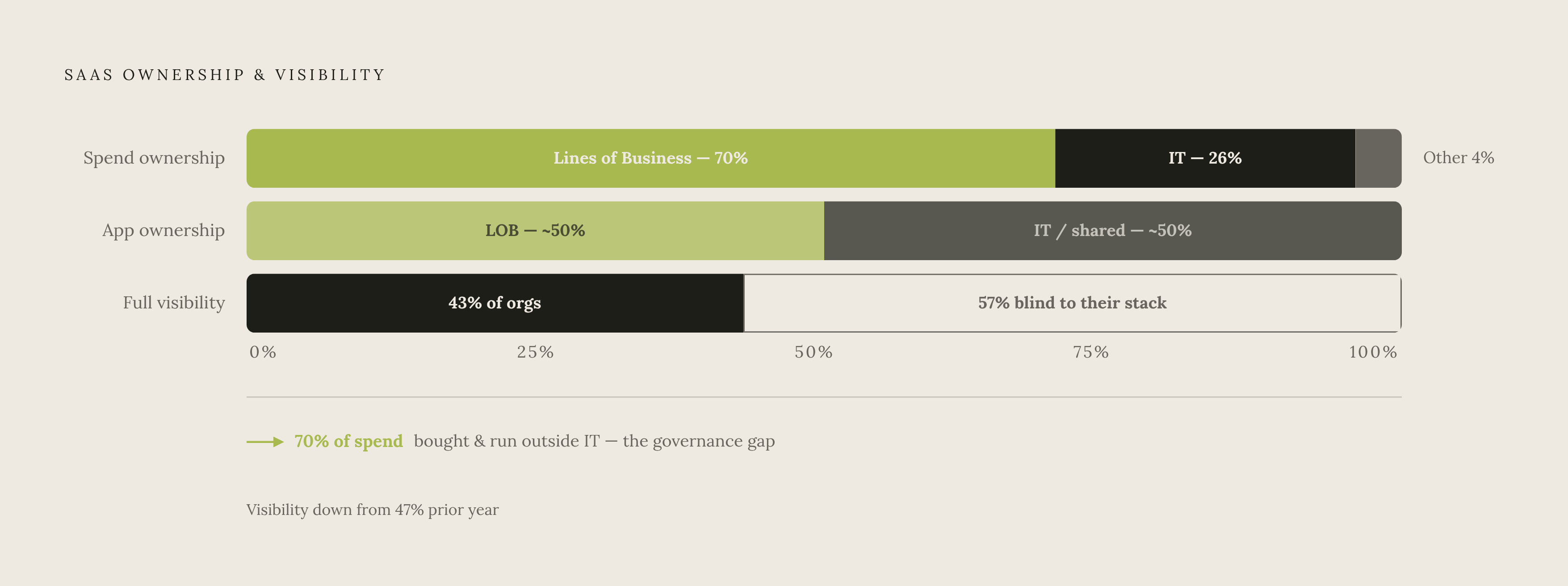
The Deloitte Global ITAM Survey 2025 found that 69% of organizations report a rise in shadow IT and unauthorized SaaS purchases specifically when licensing decisions are partially or fully decentralized. Which raises an obvious question: who's actually buying all this software? According to breeze.pm, lines of business own roughly 70% of SaaS spend and about half of all apps in use, while IT controls only around 26% of spend. Most of the sprawl is the result of there being no central plan. It's the result of there being no central plan.
Visibility is getting worse, not better. Complete visibility across the tech stack has fallen to 43% of organizations, down from 47% the year before, per breeze.pm. The same source found 66.5% of IT leaders reported unexpected charges tied to consumption-based or AI pricing models, a billing surprise that appears on a card statement before anyone in finance saw it coming.
2026 adds a new wrinkle. Employees are now bringing generative AI tools into their daily workflows without IT approval, a parallel track of unmanaged software feeding company data into models and producing outputs nobody's reviewing. It's shadow IT's next generation, and it moves faster than the last one did.
The security math is not abstract. IBM's 2024 report found one in three data breaches now involves shadow IT, at an average cost of $4.88 million per breach. Insideconsulting found companies averaged 4.3 orphaned apps and 7.6 duplicate subscriptions in 2025, and those aren't just wasted dollars sitting in a budget. They're unmanaged integration points, each one a small, unattended door into company data.
This is the governance gap, and it's what turns sprawl from an annoying cost into a structural one. A company can't retire, consolidate, or integrate what it can't see in the first place.
The financial weight of integration and technical debt at scale
Accenture's research puts the cost of technical debt in the United States at $2.41 trillion annually. That number is large enough to be almost meaningless on first read: it represents not new spending, but money spent servicing decisions made years earlier.
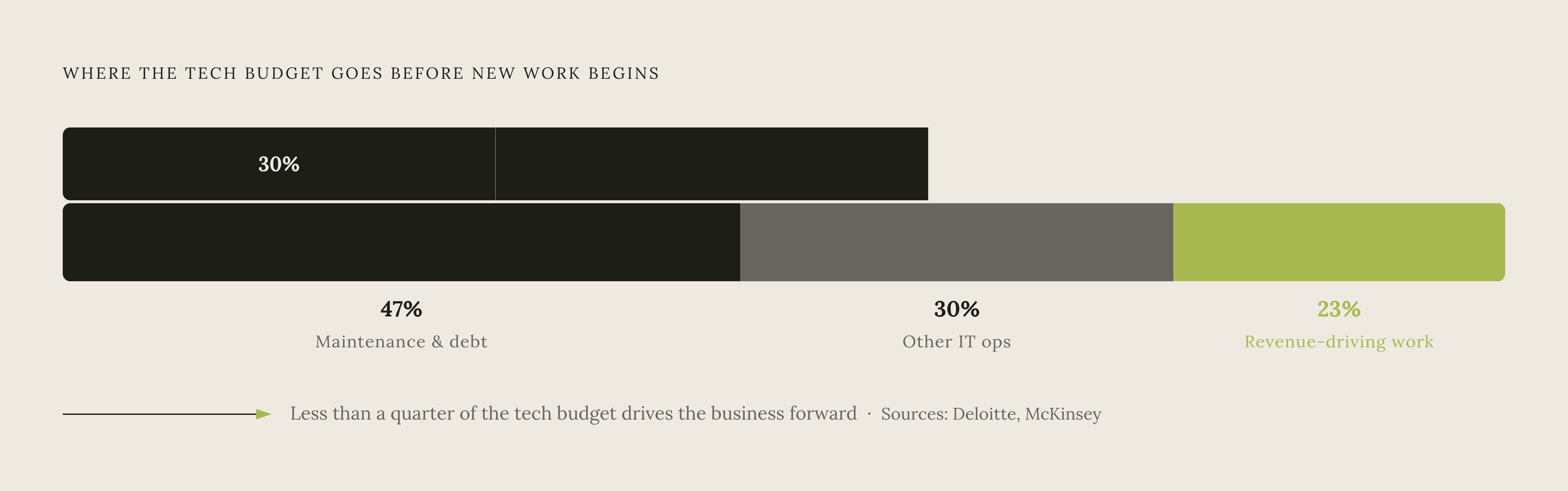
Deloitte's Global Technology Leadership Study estimates technical debt absorbs between 21% and 40% of total IT spending. For every dollar a company spends on IT, up to 40 cents goes toward keeping existing systems alive rather than building anything new. McKinsey found that 30% of CIOs report more than 20% of their new-product budget gets diverted to debt-related issues before a single line of new code gets written. That's a growth tax, and it gets paid before the work even starts.
Research found that a typical organization spends just 23% of its tech budget on activity that actually drives revenue. The remaining majority goes to maintaining and fixing what's already there. Industry analysis has found that a large share of leaders believe significant value remains trapped inside their existing tech, data, and people, unusable simply because the systems around it won't let it move.
License waste is the part of this that's easiest to point to. Zylo found only 49% of provisioned licenses are actively used, and organizations waste $21 million a year on unused licenses, up 14.2% year over year. Industry projections suggest that organizations failing to achieve centralized visibility and coordinated SaaS lifecycles will substantially overspend through 2027 from unused entitlements and overlapping tools alone.
But license waste is the invoice the CFO actually sees. Integration debt is the tax that never appears as a line item anywhere, and it quietly consumes the largest share of engineering capacity and decision quality in the building.
Where integration debt is born: the MVP and early-stack decisions that compound over time
Technical debt splits into two categories, according to ardura.consulting: deliberate debt ("we know this isn't ideal, we'll fix it after launch") and inadvertent debt ("we only found out this was bad design a year into production"). Integration debt follows the exact same split. Someone knows a workaround is temporary, or someone doesn't realize the workaround was ever a workaround at all.
The connect-later assumption usually gets baked in at the MVP stage. A team ships fast, assumes refinement comes next quarter, and next quarter never circles back. The workaround becomes the permanent architecture, quietly, without anyone deciding that it should.
AI-generated code and no-code tools have sped this up. Industry research has found that AI amplifies productivity in teams with strong engineering practices already in place, but accelerates technical debt and quality problems in teams with weak development workflows. The integration layer, the part connecting one system to another, tends to be the least considered piece of the design when speed is the only goal.
Stack Overflow's 2025 developer survey found 66% of developers frustrated by AI-generated solutions that were "almost right," close enough to pass a glance but wrong in a way that becomes visible later. Many said debugging AI-generated code actually takes more time than writing it from scratch would have. Accepting glue code because it appears to work defers the real complexity into a system that's harder to test, harder to change, and harder for anyone to reason about six months later.
Post-mortems of failed AI deployments have repeatedly found the root cause wasn't model quality. It was data readiness and technical debt: the systems AI needed to read from and write to were in such disrepair that reliable operation was never really possible to begin with.
The stack that makes sense in year one is the debt in year five. Small teams tolerate manual bridging when headcount is low and nobody's drowning yet. By the time the company hits real scale, TekStack notes, the cost of those early shortcuts has compounded into something that needs a rebuild, not a patch. None of this is a moral failing. It's a predictable stage every growing company passes through, and the right moment to deal with it is when real users and real scale occur, not years before and not years after.
What addressing integration debt requires and what merely looks like it does
There's a real difference between patching individual integrations and rebuilding on a foundation that doesn't need constant bridging in the first place. Most early remediation efforts fall into the first category, which explains why the debt keeps piling up even after teams "address" it.
The real alternative is to treat the application portfolio as a designed system, with capabilities mapped to actual business outcomes and deliberate calls made about what to centralize, standardize, integrate, or retire. That's a different posture than reacting to whatever broke this week.
TekStack found that companies who do consolidate onto unified platforms tend to arrive at the same hindsight, almost without exception: they waited too long, the migration was harder than expected because integration debt had already scattered data across many systems, and the main payoff turned out to be operational clarity, not necessarily the cost savings they went in chasing.
Genuine remediation tends to include a full audit of the stack, shadow IT included (nothing gets fixed that nobody can see), a clear read on which integrations are load-bearing versus which only exist because a workaround calcified into permanence, and a rebuild of the connective layer on solid ground rather than another patch on the existing glue code. Governance has to follow, or the debt just starts rebuilding itself the moment the audit's done.
What looks like remediation but isn't: stacking another middleware layer on top of the integrations already straining under their own weight. Consolidating licenses while leaving the underlying data architecture untouched. Treating integration as a project with an end date instead of an ongoing responsibility somebody actually owns.
Founders and operators are rarely well-positioned to own this kind of remediation themselves, and that's not a knock on their capability. It's a matter of bandwidth and vantage point: the work requires someone who can treat the whole system as one designed thing, who stays through the transition instead of handing off a deliverable and moving to the next client, and who maintains the foundation once it's built rather than disappearing after launch. Getting a product to launch and keeping it reliably alive are two different standards, and a single broken integration flow can cost a company a customer, or a data asset, permanently.
Nonprofits carry a version of this problem that's easy to overlook. The same integration debt piles up, often under tighter budget constraints, with staff wearing three or four roles at once. The cost of manual workarounds there is paid in mission capacity, in the programs and outreach that don't happen because someone spent the afternoon reconciling two spreadsheets by hand. It's paid in mission capacity, in the programs and outreach that don't happen because someone spent the afternoon reconciling two spreadsheets by hand.
Signs your stack has an integration debt problem worth acting on now
Five signals tend to appear once integration debt crosses from annoying to growth-limiting.
Cross-functional reports need manual reconciliation across more than two systems before anyone can actually make a decision. Engineering time goes disproportionately toward keeping existing integrations alive rather than building anything new. A new hire adds software cost before contributing any operational output, since per-seat licensing across a fragmented stack means headcount and spend scale together in exactly the wrong direction. Data sits in whatever tool created it instead of flowing to wherever the decision actually gets made, so "where are we with this account" still means four tabs and a guess. And shadow IT is known to exist, but nobody can say how much of it there is, which means visibility has already dropped below the point where governance is even possible.
The right time to act is when real users and real scale have already shown up, not when the debt is at its largest. It's when real users and real scale have already shown up that the cost of one broken flow turns from a minor inconvenience into a lost customer.
Gartner predicts 80% of technical debt will be architectural by 2027, needing a rebuild rather than a patch. Organizations that wait for the problem to show up clearly in the budget are choosing the more expensive version of this fix over the cheaper one available right now.
Think of it as a growth lever rather than a cleanup job. Founders who address integration debt at the right moment free up engineering capacity to spend on go-to-market work instead of production fires. The ones who wait end up managing incidents instead of managing growth.
Anyone who counted three or more of those five signals against their own stack while reading this is already past the point where a patch will hold. What remains to be decided is whether the next phase of growth builds that in on purpose, or lets a crisis nobody scheduled arrive later.