Post-Launch Monitoring Gaps as a Hidden Growth Risk
Silent failures after go-live erode retention, so audit monitoring first.
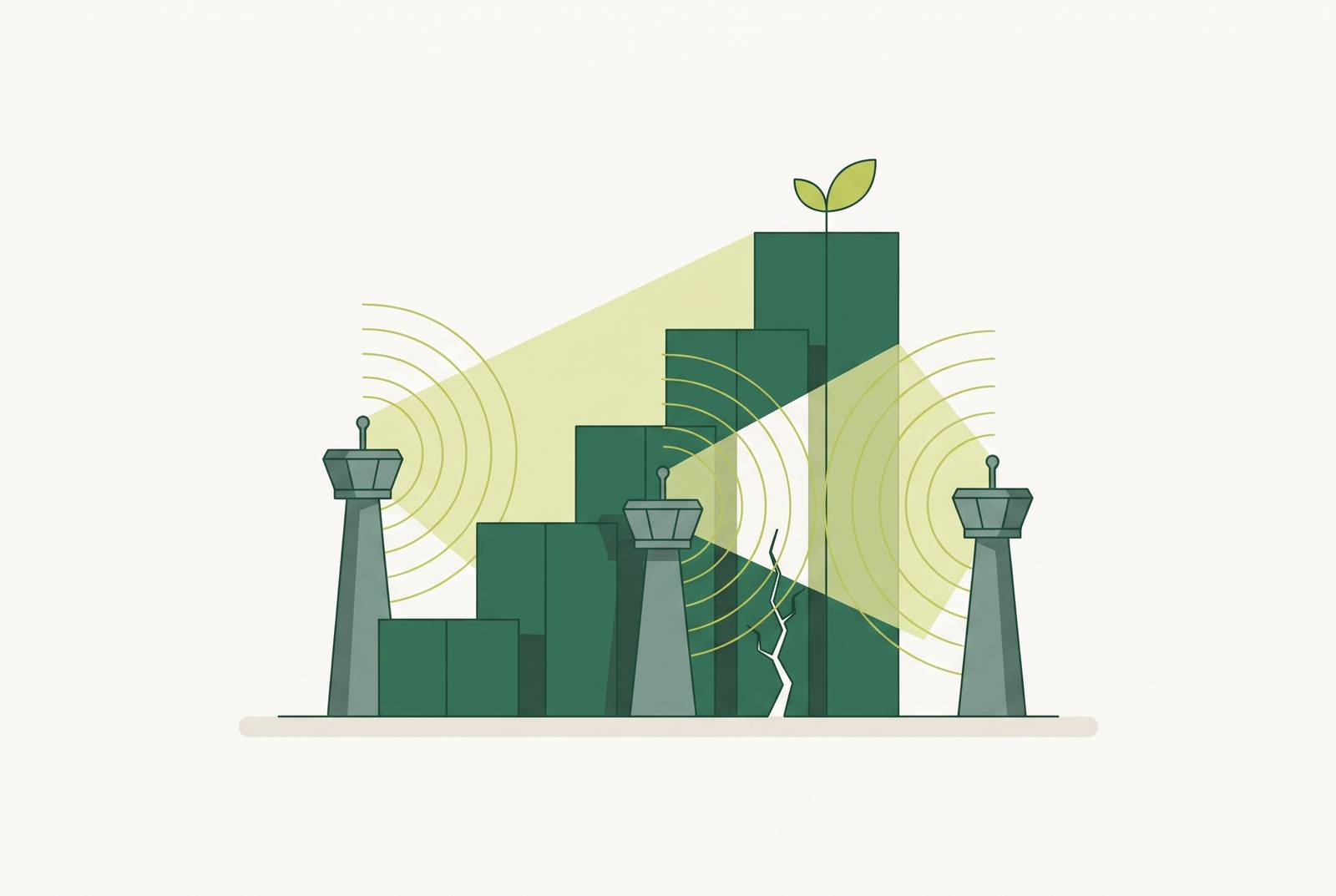
Post-launch monitoring gaps are a hidden growth risk because silent failures can erode trust and retention before a team knows anything is wrong. A technical debt assessment before hiring an engineering partner should therefore examine code quality, production correctness, alert quality, dependencies, recovery paths, and post-launch ownership. Closing those gaps is a prerequisite for scaling, rather than work to leave until after the next release.
Why the launch moment is the wrong finish line
The go-live email has gone out, the product is live, and the founders can finally breathe. The build phase has reached its goal. But launch also starts the exposure phase, when real users, data volumes, and failure modes meet a system that was tested under controlled conditions. The first weeks bring habits and workarounds that no staging environment reproduced, against a traffic mix that planning could only predict. Having shipped, the team now needs to see what happens next.
What monitoring was actually built for, and why that is not enough after launch
Traditional monitoring answers a necessary but limited question. Is the system up? Application performance monitoring tracks signals including latency, traffic, errors, and saturation, which reveal crashes, slow endpoints, and overloaded resources. They do not establish whether a running system is doing the right thing for its users. A successful response can still have the wrong price, a wrong permission decision, or poor generated output.
Alert thresholds are usually set before deployment and before people have used the system, based on how teams expect it to behave. Lightrun’s SDLC reliability analysis illustrates how a planning assumption about a data type can pass through development and testing into production without throwing an exception or causing a latency spike. Nothing looks broken to the existing alerts. Green dashboards and wrong outputs can coexist because the monitoring was never configured to distinguish them.
How AI-accelerated development widens the gap before launch even happens
AI coding tools and no-code platforms compress the build phase, but speed does not supply production context. Lightrun describes coding agents producing work faster than teams can fully review it, without accumulating the knowledge of edge cases and real data that experienced engineers develop over time. An agent can generate tests and produce a clean continuous integration result while testing an assumption that does not hold in production. The tests pass for the wrong reason. A working demo and a maintainable, monitorable foundation remain different achievements.
The January 2026 MoltBook case makes that distinction concrete. Three days after launch, security researchers found that the AI-agent social platform’s production database was fully exposed and that API tokens, email addresses, and private messages could be accessed through its normal API. Some messages had plaintext third-party API keys in them. The founder had written none of the code, and the exposure involved an API key left in client-side JavaScript and row-level security that had never been enabled. The case shows why teams need to check systems in production, whatever their choice of AI tools.
Monitoring would not itself have written the missing access controls. Appropriate security observation could, however, have surfaced the exposure before researchers did. Faster construction leaves less time for assumptions to become visible through review. Launch readiness must account for what the build process has not established.
The specific monitoring gaps that go unnoticed longest after launch
Without a quality baseline recorded before go-live, a team cannot reliably tell drift from normal behavior. Semantic failures in AI-generated output and other results deepen that blind spot because meaning and business correctness lie outside the scope of infrastructure metrics. Permissions logic, pricing calculations, and data transformations can all give results that look valid while doing the wrong thing.
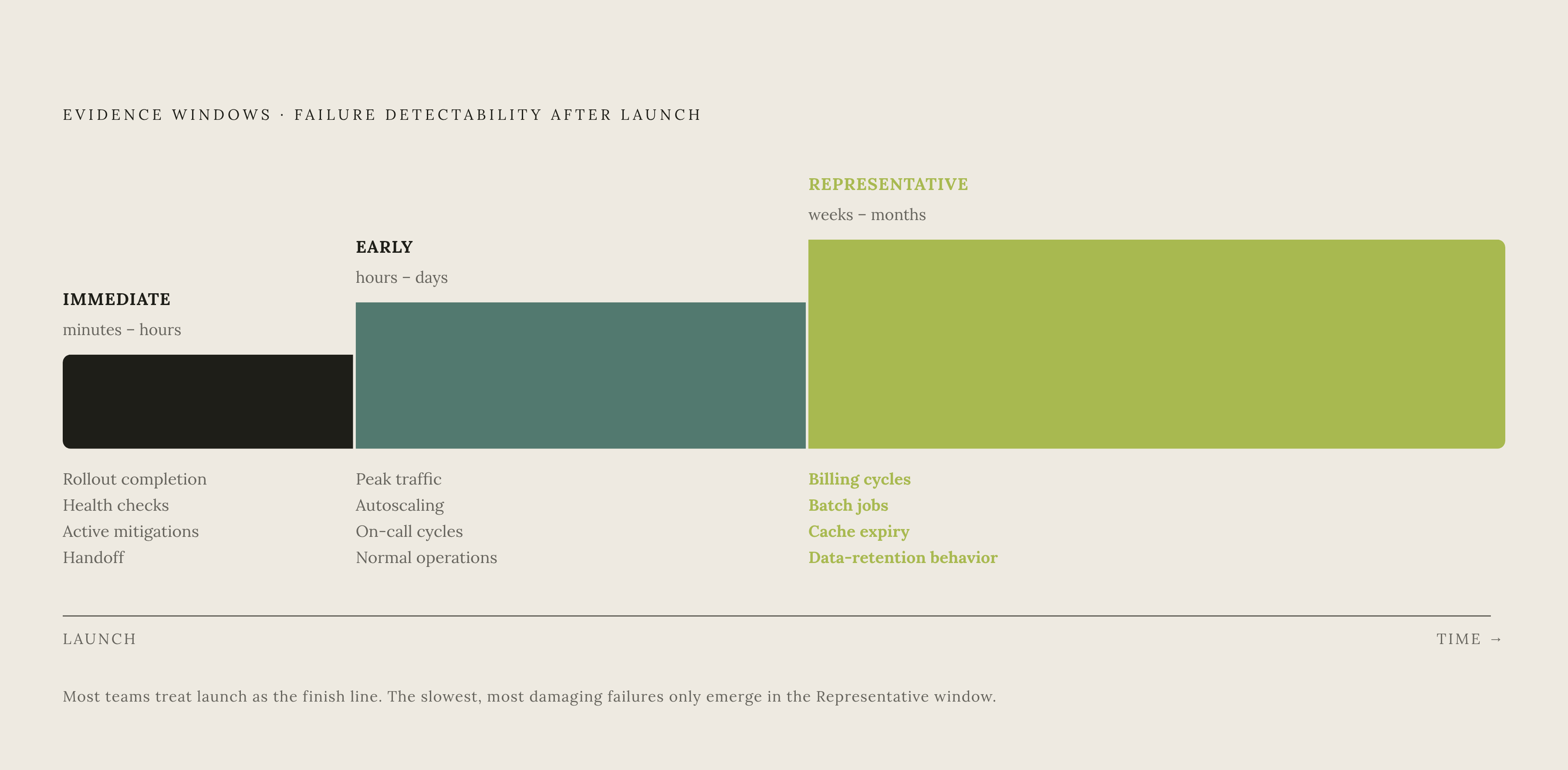
A threshold calibrated to pre-launch expectations may stay quiet through a substantial regression, especially when the service still meets its service-level objective. OneUptime’s post-launch readiness review framework distinguishes immediate, early, and representative evidence windows for this reason. Peak traffic reveals some weaknesses, while monthly billing or cache expiry reveals others. A quiet first hour offers no evidence about a cycle that has not happened yet.
Gaps in dependencies become visible under real traffic. Retries and request fanout can push production calls beyond forecasts, while throttling changes how those dependencies behave. An autoscaler may eventually reach the right replica count but arrive too late for the launch spike. These failures can hide behind acceptable averages or an apparently adequate final capacity. Their defining feature is a mismatch between the forecast and the timing of actual demand.
Recovery and alerting gaps can remain dormant even longer. Destructive cleanup after an apparently successful rollout can remove rollback-compatible schemas, artifacts, and configuration before the observation window closes. Meanwhile, a page that should fire may never do so, a silence may hide impact elsewhere, or a linked runbook may turn out to be unusable. These are failures of the safety system itself. Google SRE practice holds that launch should not be the first time the query, notification route, and runbook are exercised together.
Why the accountability gap between vendor and operator lets these gaps persist
Once a gap is visible, who owns closing it? Standard development engagements often organize support around the launch event, while monitoring, security updates, and later fixes fall to the client. That is a contract boundary. The problem appears when the client has no internal team prepared to take over. Assuming continuing support is included leaves the organization with responsibilities but no agreed remediation path.
AI systems add another boundary between the developer, deployer, and the organization that puts the system into a workflow. Responsibility can become unclear at each handoff. The EU AI Act requires plans for post-market monitoring of high-risk AI systems, while the NIST AI Risk Management Framework treats post-deployment monitoring as a key part of how those systems are governed. A software update, changed data pipeline, or new workflow can alter behavior without necessarily triggering a formal reassessment.
How the gap concentrates in nonprofits and resource-constrained organizations
Limited engineering capacity sharpens the same ownership problem. A nonprofit inheriting a freelancer-built tool or AI-built application may have no continuing technical partner to investigate silent degradation. Its monitoring gap then threatens mission continuity. Donor management, program reporting, and operational records rely on systems that someone must keep watching. A working handoff does not establish that capacity.
Momentive Software and Wakefield Research’s survey of 500 U.S. nonprofit executives, published August 2026 with fieldwork done in May 2026, found that growth in revenue was putting strain on the technology they relied on. A majority relied on a single person to manage all financial operations. That concentrates the risk. The same survey found that a majority had adopted AI, but most kept AI oversight within IT, leaving accountability concentrated in a department that may lack post-launch monitoring capacity.
In that setting, a silent failure need not resemble an outage. It can emerge as a missed reporting deadline, damaged donor trust, or data loss from a migration that appeared successful. Nonprofits therefore illustrate the general argument at its highest stakes, where a gap in technical ownership can interrupt the work the organization exists to do.
What should a structured post-launch technical assessment cover, and when should it run?
A post-launch readiness review compares predictions with production evidence while the launch context is still fresh. It does not wait for an incident. OneUptime presents a concrete model in which a significant incident triggers a separate postmortem, with the two records linked. The review still happens after an apparently healthy launch. Its purpose is to discover where success depended on assumptions that have not yet been tested.
The timing depends on failure latency and usage cycles rather than on one date that happens to be convenient. The immediate window covers rollout completion, health, active mitigations, and handoff. The early window includes peak traffic, autoscaling, on-call work, and normal operational cycles. The representative window extends to relevant billing, batch, cache-expiry, and data-retention behavior. Before launch, people are assigned to own the calendar, and rollback-compatible schemas, artifacts, and configuration stay available until the agreed window ends.
The review begins with an evidence-backed deployment timeline. Exact artifact versions, configuration and feature-flag states, database migrations, traffic steps, pauses, alarm results, and rollbacks are compared with the reviewed plan. This shows where the process drifted even if health metrics stayed green. Correctness then receives a separate examination because successful HTTP status codes do not establish that prices, permissions, generated data, or business side effects were right. The quality baseline gives that examination a reference point.
Alert quality deserves equally concrete scrutiny. For every page, ticket alert, suppressed alert, and issue found by hand, the team needs to ask whether it was caught early enough to change what happened. Did the runbook work? Were duplicates grouped, and did any expected alert fail to fire? Capacity reconciliation then compares forecast demand, requests per user action, resource costs, cache hit ratios, scaling delays, quotas, and dependency fanout with measured production behavior.
For a team assessing technical debt before signing with an outside engineering partner, these dimensions provide a practical assessment scope. An example deliverable is a scored register covering correctness, alerting, dependencies, capacity, rollback readiness, and ownership, with supporting evidence. The distinction is important when comparing proposals. A review of the repository can assess what was built, while this production-focused assessment also tests whether anyone can detect and recover from its failures. A clean build or a broad promise of support leaves that second question open.
When the data layer itself is the monitoring gap: Airtable at scale
Teams using Airtable as an operational database may sync production data into it for business users, then sync changes back. That creates two copies of the source of truth without necessarily providing reconciliation monitoring. Disagreement can remain invisible to application health dashboards. The operational data layer becomes the place where correctness is least clearly established.
Moving to Postgres or Supabase does not automatically resolve that problem. Airtable automations, alerts, and integrations do not transfer by themselves, and the new environment has no default mechanism proving that those functions still work. The transition needs its own observation window. Otherwise, a migration can appear successful while losing the signals that made the old workflow manageable. The gap during and after migration can be at least as large as the one the move was intended to close.
The alternatives described in the late-2026 material distribute those responsibilities differently. NocoDB connects directly to an existing database, removing the sync layer and keeping one source of truth, but self-hosting puts technical setup, backups, and security with the operator. Baserow is also open-source and self-hostable, with no SSO on its free self-hosted edition and similar operator responsibilities. Grist supports native Python formulas and row-level access control for teams whose stakeholders need to see different views of the data used in their work. These differences concern architecture and access.
Other options address different constraints. Notion’s performance degrades on large databases, and it cannot replace a downstream data hub where Airtable was feeding a warehouse sync. SeaTable offers EU-based servers and a self-hosted option with a GDPR-focused design, which is relevant to organizations handling sensitive constituent data. No choice removes transition risk by itself. The migration must preserve correctness, access, integrations, and monitoring continuity.
Closing the gap requires a partner who stays on, not a handoff
The strongest evidence of post-launch capability is a named support offering with defined response times and explicit monitoring scope. A general mention of ongoing support leaves too much unresolved. A continuing partner instruments monitoring before go-live, maintains recovery paths through the representative window, and audits alerts against real traffic. That partner also takes charge of dependency and capacity reconciliation, so those tasks have an owner across the organizations. Those responsibilities make the support promise assessable before a contract is signed.
For founders who launched with AI tools or a freelancer, this assessment is not a verdict on the original build. The transition from working demo to monitorable production system is a known, addressable stage. It is not a reason to rebuild before understanding what is missing. The next engagement should begin with that evidence and assign ownership for the weeks and months in which slower failures emerge.