How Code Architecture, Infrastructure Maturity, and Team Process Are Scored Before an Engagement Begins
A structured rubric reveals inherited technical risks before an engagement costs time and money.

A technical debt assessment before hiring an engineering partner should score architecture, code quality, infrastructure maturity, and team process, because each reveals a different kind of inherited risk. A structured rubric turns those findings into a scored risk register that helps both parties decide what can proceed, what needs repair, and what the engagement should cost.
Why a pre-engagement assessment covers more than code quality
A code audit examines source code for quality, security, and maintainability, while a technical assessment also asks whether the technology supports the business plan. Can the team keep the system alive? What will the product cost to change? These questions cannot be answered from source files alone, yet a partner needs answers before committing to a roadmap and budget.
DevEntia’s 2026 checklist frames the core question as “can this system support the plan the price assumes?” AI-generated and no-code codebases make that question harder to answer through familiar proxies such as team size, elapsed time, commit history, and code style. A small team using AI tools can produce a repository that looks like years of work by a larger team. Appearance no longer establishes how thoroughly it was reviewed. For a founder bringing an AI-assisted MVP to a production engineering partner, the assessment establishes what actually exists beneath the working product.
How scoring rubrics convert observations into a structured risk picture
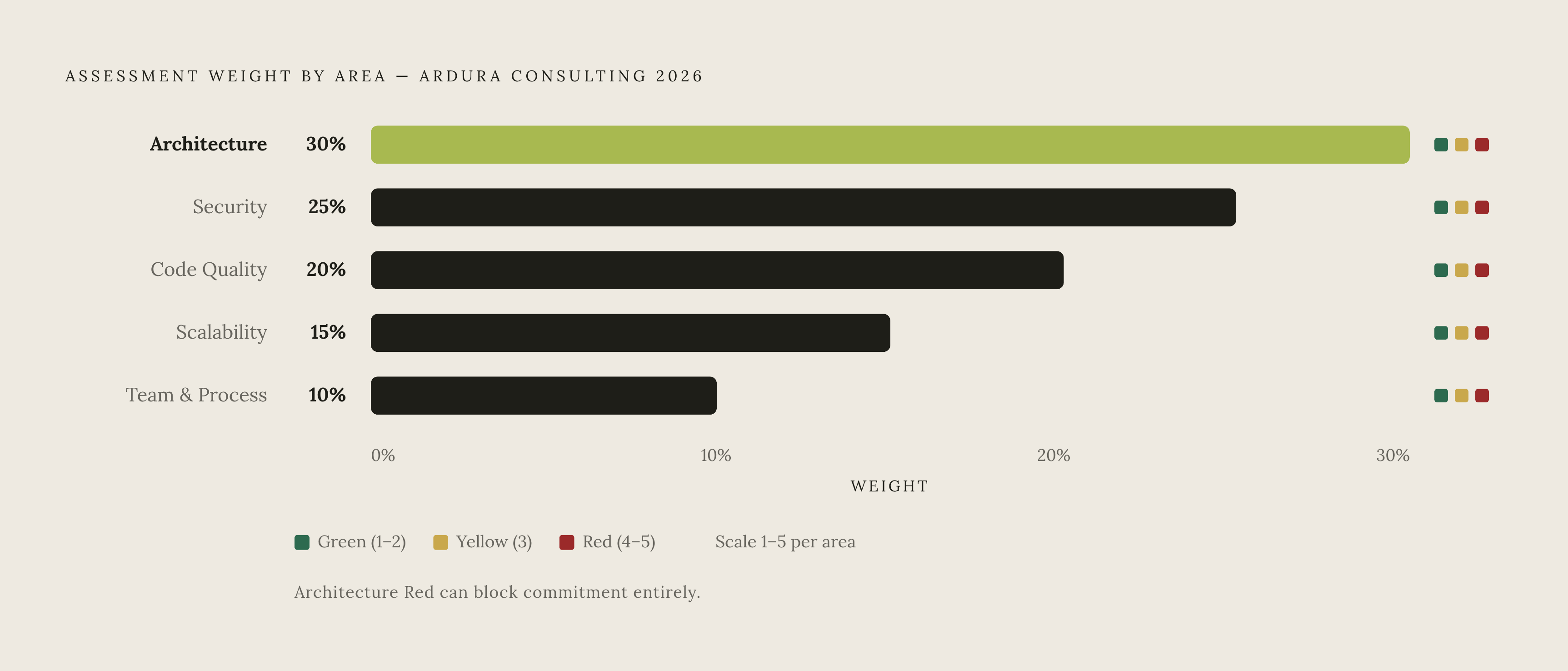
A rubric turns qualitative observations into a weighted composite score. Reviewers score each area against named criteria, then combine the scores based on how much weight each carries. Ardura Consulting’s 2026 template scores code quality, architecture, security, scalability, and team and process on a 1–5 scale. Architecture has the highest weight because flaws in the structure cost more to fix later. The categories can overlap in a review, since a finding about infrastructure can also affect security or scalability.
The number alone is not enough to explain severity. A Green / Yellow / Red layer below the numeric score helps readers see how serious each finding is. A composite score of 2.4 is abstract, while Red on architecture identifies the area that prevents a safe commitment. In a scored register, a finding such as an undocumented data model connects the rating to something concrete. That link helps a non-technical founder see why a score changes the work being proposed.
The rubric provides a basis for deciding whether to proceed, reprice, or rebuild. It also keeps a critical finding from disappearing inside a general impression that the product looks healthy. A working application can still contain a risk that changes the engagement’s terms. The rubric tells the founder and prospective partner what they are agreeing to before work begins.
What the architecture score is actually measuring
Architecture scoring asks whether the system can absorb change without disproportionate cost. Reviewers examine system design, data architecture, and integrations, starting with whether the team can explain the design and whether its diagram matches the running system. The architectural pattern might be a monolith, microservices, a modular monolith, or event-driven. Reviewers assess whether the pattern suits the product’s actual complexity and traffic.
Coupling and cohesion make that judgment more precise. Coupling is how tightly components depend on one another, while cohesion is how clearly each component has its own job. Together, they help show whether a change stays in one place or forces changes elsewhere. What happens when the product changes direction? A design that needs a rebuild to change carries different risks from one whose boundaries allow it to change. Architectural drift causes another problem when the documented design no longer matches the code and the documentation misleads the people who use it.
Reviewers look just as closely at the data model because it shapes how the application behaves. Reviewers examine whether it is normalized, documented, and consistent, and whether the database choice fits the actual data patterns. A relational, NoSQL, or time-series database needs a reason grounded in the product. Version-controlled schema migrations, enforced referential integrity, and application-level validation distinguish a managed model from one held together by ad-hoc production changes.
Reviewers map APIs, third-party services, message queues, and file transfers, then look for concrete resilience measures such as circuit breakers, retries, and fallbacks. API versioning shows how breaking changes are managed for consumers. Recovery needs evidence too, including automated, tested backups recoverable within a defined recovery time objective, or RTO. An undocumented data model combined with no architecture diagram can move the assessment from Green to Red because an incoming partner cannot safely reason about changing it.
What the code quality score reveals that architecture diagrams cannot
Even a sound design can lead to code that is hard to maintain. Code quality scoring therefore combines automated analysis with manual review, since each exposes problems the other can miss. SonarQube, ESLint, and Pylint are examples of tools used for static analysis. More specific findings include cyclomatic complexity, duplication rates, and known vulnerabilities in dependencies. These signals connect the condition of the code to the work required to test, maintain, or secure it.
High cyclomatic complexity points to functions that are difficult to test and maintain. Elevated duplication suggests missing abstractions and creates repeated maintenance work, while dependency scans identify known CVEs in the dependency tree. Severity can override the broader quality score. A critical dependency vulnerability is still a security finding even when other code metrics look healthy. Manual review then checks naming, separation of concerns, error handling, and consistency in ways that automated scores cannot.
History helps distinguish a contained problem from a growing one. Reviewers look at meaningful commit messages and pull request reviews for signs that someone checked the changes carefully. They also count and categorize TODO/FIXME/HACK comments, because a growing backlog signals accumulating debt. Direction is more revealing than a single snapshot. Moderate complexity rising steadily can be more concerning than higher complexity that has remained stable for years, where the cost is already understood and priced.
DevEntia treats the absence of an AI usage policy as a reason to assume unvetted AI-assisted contributions are present and to price the review debt accordingly. Has the generated code been tested and governed? That is the useful distinction for a founder who used AI to ship an MVP. Technical debt is a predictable stage of product development, and AI assistance calls for appropriate assessment.
What infrastructure maturity scoring examines and why it predicts operating cost
Infrastructure scoring examines whether the application can be deployed, observed, and recovered reliably. Architecture describes the design, and code quality describes its implementation, but neither proves that the production environment can be recreated after failure. Reviewers examine CI/CD pipelines, rollback capability, and environment reproducibility. An environment nobody can rebuild is a Red flag. Docker, Kubernetes, and serverless functions are judged by their suitability.
Security review extends to network architecture, access controls, secrets management, and encryption standards. DAST tests the running application, while SAST analyzes source code without executing it. These checks address different views of security. Observability then determines how efficiently the team can investigate production problems through structured logs, tracing, and alerting. Without that visibility, an incoming partner must spend unplanned time establishing it before making changes safely.
Incident response documentation, penetration testing results, and evidence of SOC 2 readiness also show how well the team runs the system. Backup and recovery appear here as well as in architecture because recovery depends on both design and operation. A backup’s automation, testing, and ability to meet a defined RTO need to be established as proof of recoverability, and a failure is critical wherever the review discovers it.
These weaknesses are often invisible while the product is running well. An untested backup, a manual deployment step in a critical path, or a production secret stored in a repository can still change the engagement plan. DevEntia includes untested backups among the findings that most frequently change deal terms in pre-acquisition diligence. Operating cost therefore includes more than keeping the application online today. It also includes the work needed to deploy changes, diagnose failures, and recover without an extended outage.
How team and process scoring surfaces the risks that code cannot show
Team scoring checks whether the engineers now on the team understand the system’s critical paths. In whiteboard interviews without code access, reviewers check whether key people can explain from memory how payment, authorization, and data-isolation work. Static analysis cannot answer that question for them. A single unowned critical path can be Red even if the code is not demonstrably wrong, because nobody can confirm that it is right. Knowledge concentrated in an unavailable engineer creates a continuity risk that can reprice the engagement.
Does code review actually gate merges, or does the policy exist only on paper? Linters, static analyzers, and automated checks enforced by tooling are stronger evidence than trusting people to follow the rules when a deadline is close. An AI usage policy belongs in this review, as does a documented, practiced allocation for technical debt remediation. The distinction is between debt that is managed and debt that accumulates unnoticed.
Ownership brings risks that code scans or interviews alone cannot settle. Reviewers examine whether rights to code written by contractors or agencies have been assigned and whether ownership questions around AI-generated contributions are documented. Unassigned IP can change the terms of a deal. A founder may not legally own what an agency built if ownership was never formally assigned. Open-source license obligations, including those associated with GPL and AGPL code, also need to be tracked in a software bill of materials.
Documentation makes both technical knowledge and past decisions transferable. Architecture decision records capture not just what the team chose, but why, giving an incoming partner context before it changes the system. Handover costs more when knowledge is held only in someone’s head. The same concern applies to the partner’s own process, since a long-term relationship needs knowledge to last beyond the people who hold it. Process maturity is therefore part of partnership readiness.
How founders can use these scoring dimensions to prepare before an assessment begins
For founders preparing to audit a codebase before bringing in an outside development team, the practical step is to assemble evidence against these dimensions. Produce or update an architecture diagram that matches the running system, document the data model and external integrations, and confirm that backups are automated and tested. Creating the diagram is useful work in itself. It can reveal dependencies and architectural drift before the partner encounters them during delivery.
For code quality, run static analysis and act on critical findings, then check test coverage and write down how the AI-generated modules work. Establish or document an AI usage policy, even if it is informal. The aim is an honest debt inventory. When a weakness is documented, the partner can assess and price it, but a clean-looking repository leaves the scope unclear if no one knows how it was reviewed.
For infrastructure, confirm that someone other than the original author can run the deployment pipeline end to end. Verify that secrets are not stored in source code, and document the incident response process even if it is minimal. Then test the human side of the handover. Walk the payment, authorization, and data-isolation paths without code access, document the findings, and confirm IP ownership in writing where contractors or agencies were involved. Surface any path nobody can explain before the assessment.
The same scoring logic also helps founders evaluate a prospective partner. A team that moves straight into implementation without structured discovery leaves architecture decisions unresolved, and missing decision records before the first sprint are a process warning. Long-term incentives deserve attention as well. A partner staying through maintenance has direct financial exposure to inherited architecture and infrastructure debt, giving it a reason to assess honestly. The assessment is not a gatekeeping ritual, but a shared diagnostic that lets both parties agree on what they are building before the engagement’s first line of production code is written.