What Engineering Studios Find When Infrastructure Looks Ready but Isn't
Infrastructure that passes inspection often hides gaps in security, monitoring.
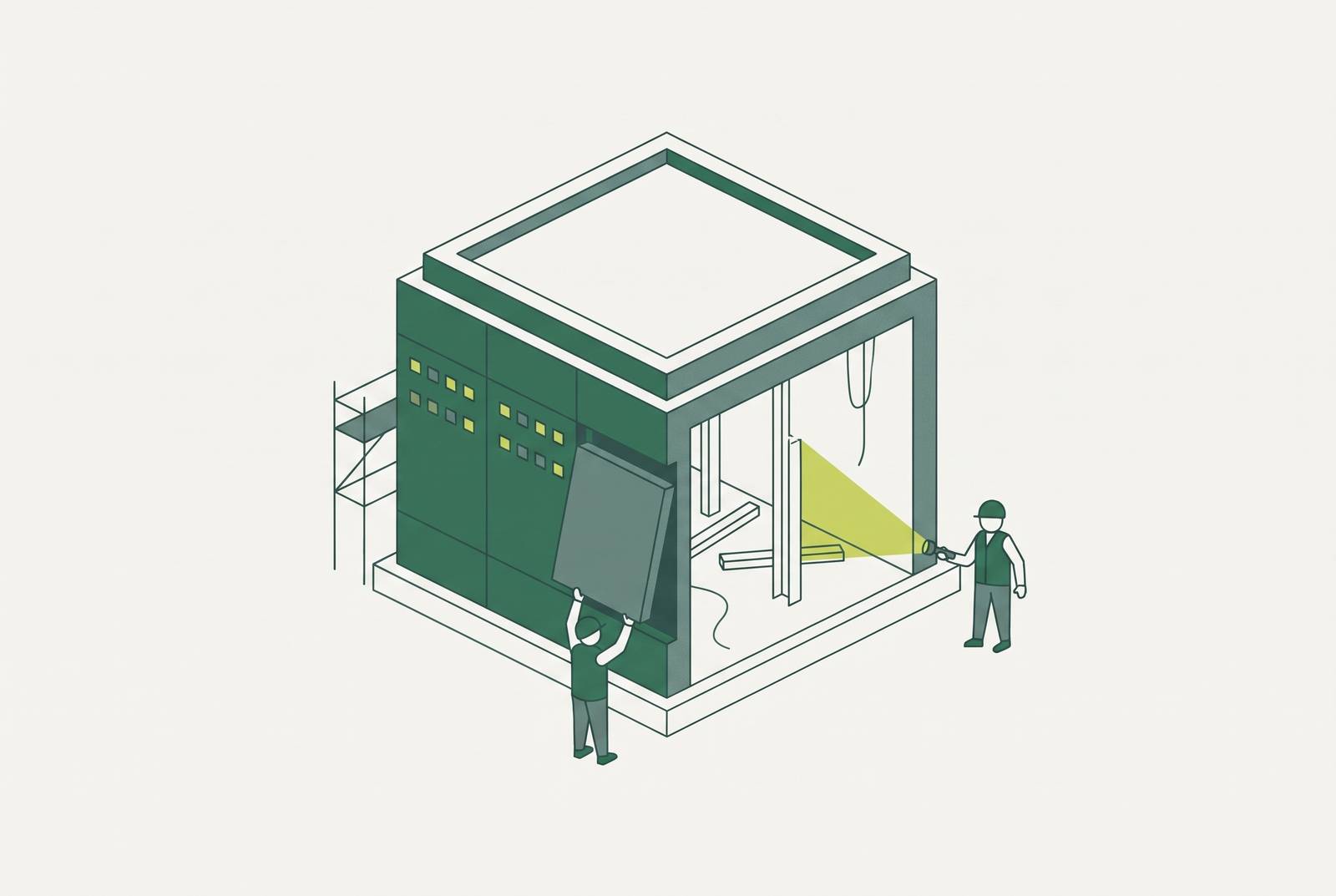
Before hiring an engineering partner, a technical debt assessment should examine authentication, observability, business logic, code comprehension, failure isolation, backup integrity, and the data layer. Its purpose is to distinguish immediate risks to real users from debt that can wait, then decide whether to harden or rebuild. Infrastructure that looks ready often has the same gaps in these areas, because a prototype that works proves far less than a production system that users can depend on.
Why the gap between "it works" and "it's ready" is structurally wider now than it used to be
Building a working prototype has become easier, while the production bar has not moved down. In 2026, that difference creates a wider gap between demonstrating a feature and operating it reliably. An AI demo can impress a boardroom without answering how the system will handle data drift, security audits, or unpredictable inference costs at scale. Those questions belong to the surrounding system. Faster feature development does not answer them.
The gap begins with a reasonable assumption that becomes dangerous when left unexamined. Founders treat MVPs as disposable experiments, so workflows get hardcoded, observability goes missing, and authentication waits. Those choices help test demand quickly. But when the experiment succeeds, the supposedly temporary system becomes the foundation for real users, and shortcuts become obstacles to growth.
AI-generated code can add more debt to that foundation. Engineers can accept working code without fully understanding it, leaving every future maintainer to reconstruct its behavior. The cost is both structural and cognitive, because changing the system requires understanding decisions that nobody deliberately made or can confidently explain.
What "production-ready" actually requires that an MVP almost never has
An MVP asks whether people will use it. A production system must answer whether they can depend on it. That distinction is not an abstract preference for cleaner code, but a different standard for observable behavior, clear boundaries, and recovery when something goes wrong. A system must be able to fail partially without failing completely.
The surrounding conditions count as much as the feature set. Data readiness, infrastructure, compliance, and organizational alignment can block production even when the model or application works. A technical assessment must also check whether the organization can understand and run what it has built.
Deliberate technical debt can still be a sound MVP choice. The condition is a plan to repay it. When studios inherit a codebase, that plan is often the missing link between the original shortcut and the product’s current obligations. Readiness depends on recognizing when those obligations have changed.
The four failure patterns engineering studios find consistently, and why each one accumulates
Deferred authentication is often the first gap that a polished interface hides. It contributes little to a convincing demo, so teams postpone it while visible features move ahead. Row-level security may never have been turned on, API keys may sit in client-side code, and credentials may still be in plaintext. Those failures can become serious security risks without ever getting in the way of development.
Absent observability follows the same preference for visible progress. If the same two engineers always diagnose incidents, the system may depend on undocumented sequencing, deployment rituals, and assumptions buried in informal conversations. Their knowledge becomes an operational dependency of its own. Logs with correlation IDs, metrics that tell dependency latency from application latency, and alerts tied to user impact show what happened in ways that memory alone cannot. Without that evidence, new engineers ship cautiously while senior engineers spend more time fielding interruptions, so adding people does not necessarily increase delivery speed.
AI systems make this gap harder to recognize because server health is not output health. A backend can respond promptly while an agent acts on corrupted data or produces poor results. Traditional monitoring may show nothing obviously wrong. An assessment that looks only at availability and latency can therefore miss the behavior users actually experience. The system is running, but its usefulness is deteriorating.
Pricing or approval rules begin in whichever layer is quickest to change, then spread across controllers, background jobs, frontend conditionals, database triggers, and third-party workflow tools. No single model has authority over the rules. Every new capability requires engineers to rediscover them in several places. A related warning appears when services, admin scripts, analytics queries, and support tools all read and write the same relational tables with different assumptions, producing phantom bugs as concurrency and permissions become important.
AI-generated code can deepen that uncertainty into comprehension debt. In an agentic workflow, a tool call may return malformed data while the model continues without crashing, leaving corrupted context to shape later actions. There is no exception to explain the failure. Prompt drift is the slower version, where a staging prompt changes, another team changes an expected output format, and production agents begin failing inconsistently days later. GeekyAnts’ CRO Kunal Kumar identifies the broader mistake as focusing only on the model rather than the infrastructure, monitoring, and cross-team alignment around it.
Why graceful degradation and backup integrity are the two failures that look fine until they aren't
Graceful degradation is hard to judge while every dependency works as it should. An MVP may call each service synchronously, without timeouts that do much, and work perfectly in a demo. The first outage changes the picture quickly. A slow downstream service holds request threads, the application exhausts its connection pool capacity, and one degraded optional feature takes down the whole product. A timeout and fallback path would have contained that cascade.
The same lack of isolation can appear in deployment practices. If every risky change depends on reverting the entire release, features, migrations, configuration, and behavior are effectively one inseparable unit. Rollback then substitutes for boundaries within the architecture. Experienced teams use feature flags, backward-compatible migrations, and progressive rollouts to keep release separate from activation, so part of the system can fail without forcing them to reverse the whole release.
A nightly database dump copied to a bucket looks like a recovery plan, even if nobody has tried to restore it. A schema migration may prevent a clean restore, or rotated bucket credentials may leave the backup job silently failing for weeks. Treating backup existence as backup validity postpones discovery until the organization needs recovery most.
How Airtable-as-backend becomes a structural limit rather than a scaling problem
A spreadsheet-style tool used as an application backend can conceal a mismatch that ordinary performance work cannot fix. Airtable has become the database behind customer portals, internal tools, and small apps, where its limits may be unobtrusive at low scale. Growth exposes more than slow requests, however. On paid plans, each base has record limits, so large datasets with relational links hit a hard limit that optimization cannot remove.
Attempts to work around the mismatch can recreate the complexity the original choice avoided. Teams sync production data into Airtable so business users can view and edit it, then sync those changes back. The interface now requires bidirectional synchronization to function. That layer introduces consistency risk and operational complexity between the business tool and the production database.
NocoDB removes the sync layer for teams that need a spreadsheet-like interface over a real database. Supabase addresses a different pair of gaps by providing a relational database with constraints and transactions, plus Row Level Security enforced inside Postgres. Generated authorization policies still need to be checked explicitly, or the migration can bring the deferred-auth problem into a different stack.
Why nonprofits hit these failure modes harder and recover from them more slowly
Nonprofits face the same failure patterns under conditions that make them harder to unwind. Budget pressure, turnover, and well-meaning customization can embed complexity before an organization has the experience to judge it. This is not evidence of worse decision-making. Tight budgets can lead to hiring junior administrators who want to help but have too little experience with architecture to push back on each new customization. Over time, the system grows beyond what anyone fully understands.
Staff turnover then turns a knowledge gap into an operational constraint. Many nonprofits rely on one person who holds the system’s logic, history, and structure in their head. When that person leaves, the undocumented operating knowledge leaves too. This is the same dependency seen when only a few startup engineers can diagnose production problems, but with fewer resources available to reconstruct what has been lost.
Disconnected software adds another layer to that dependence. Fundraising, accounting, and client management may each live in separate systems, preventing a unified view of the organization’s data. Rules and knowledge end up spread across those systems. The result resembles the fragmented business logic found in startup codebases, but creates higher operational costs for organizations with less room to absorb them. Recovery is harder because the conditions that produced the debt also constrain the capacity to repay it.
The objection worth taking seriously: not everything needs hardening before it has users
Over-engineering an MVP can consume the runway needed to discover whether anyone wants it. Technical debt is sometimes a deliberate feature of a focused build. Speed can be the right strategic choice. The distinction is between debt taken on knowingly with a repayment plan and obligations that remain invisible until users depend on the system.
An outside review can make the opposite mistake by applying enterprise standards too early. A large remediation backlog may consume money without reducing risk in proportion. Not every finding deserves work before launch. The baselines described here are what a product needs to serve real users, with a higher standard once those users arrive and no need to prepare every small product for enterprise scale.
CodeBudee draws the practical distinction between hardening an MVP whose core is sound and rebuilding one whose design resists every change or whose tools can no longer support growth. That decision requires diagnosis. A good assessment must therefore explain what can safely wait as clearly as it explains what cannot.
What should a technical assessment cover before signing with an engineering partner?
A useful assessment connects each finding to a decision about the existing system. Authentication and data-layer findings show whether its boundaries hold up, while observability and code comprehension show whether engineers can explain what it does. Business logic reveals where changes must propagate. Failure isolation and backup integrity expose whether the organization can contain an incident and recover from it.
For founders evaluating a partner, an example deliverable is a scored risk register covering those dimensions. Its value lies in the reasoning behind the scores. Each finding should make clear which failure mode is present, whether it poses an immediate risk to real users, and whether remediation can be deferred. That gives the harden-or-rebuild recommendation a basis the founder can examine, rather than turning every imperfection into paid scope.
The engagement itself also needs to fit the diagnosis. A partner that audits and hands off can leave the organization with the same staffing and knowledge constraints that produced the problem. A partner that stays through the rebuild and later growth takes on different duties from one that gets the product to launch. For founders who started with AI tools, a no-code stack, or a freelancer, the decisive question is whether the foundation can support real users or must be rebuilt while the product stays live. A studio that understands its findings makes that choice clear before asking the founder to commit.