When to Rewrite vs. Refactor a Production Codebase
Diagnose whether your codebase needs incremental improvement or architectural replacement.
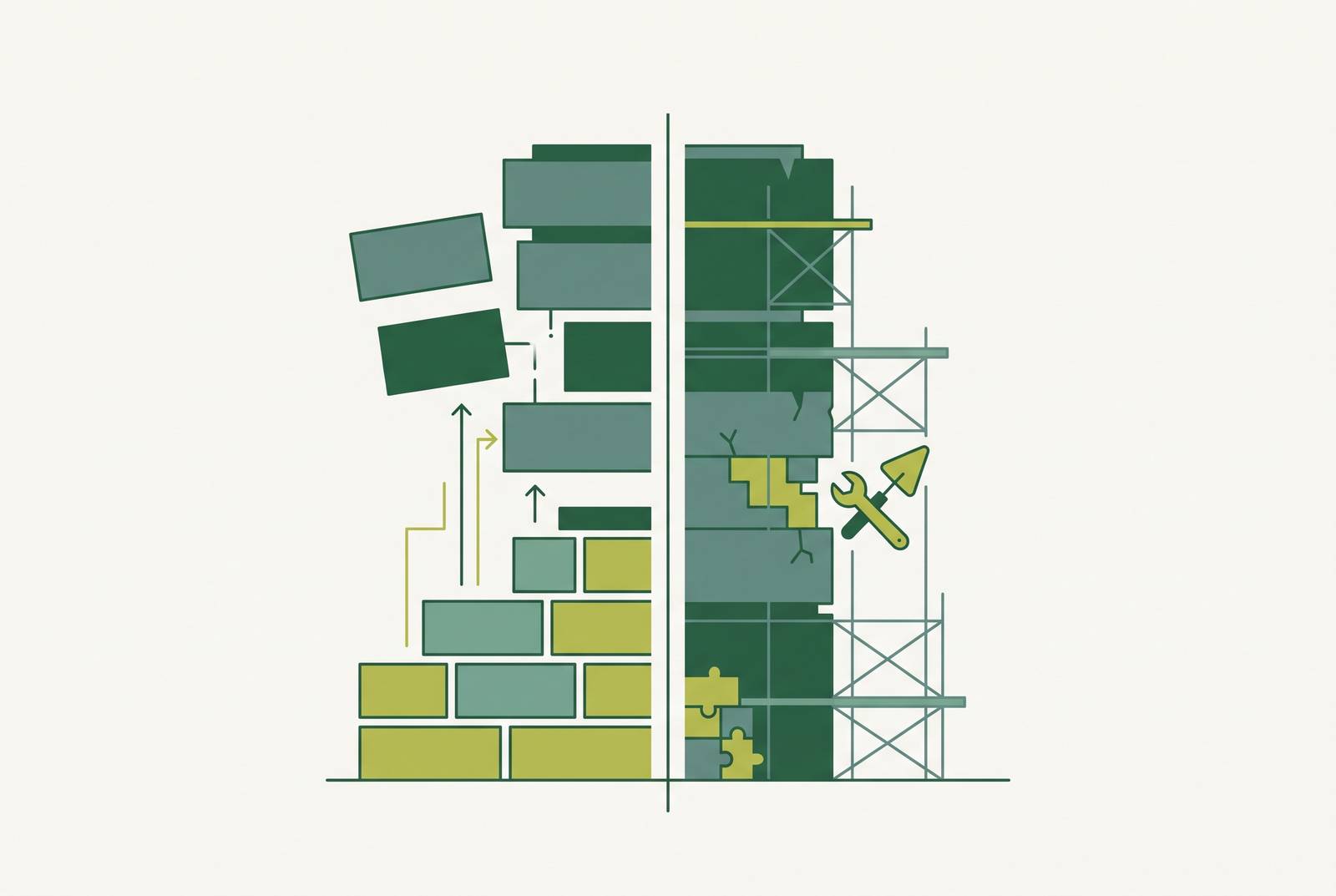
Every codebase hits the moment when someone says, "Maybe we should just rewrite this." The words hang in the air during a planning meeting, and everyone feels the pull. The rewrite-versus-refactor call is one of the most consequential decisions a software organization makes, and it is often made on instinct rather than diagnosis.
Why the rewrite-vs-refactor decision is harder than it looks
The decision cuts in both directions, and each mistake carries its own cost. Choose a refactor when a rewrite was needed, and the structural constraints stay in place. Choose a rewrite when refactoring would have sufficed, and the company burns months of runway with no business value delivered until cutover.
Part of the problem is language. The terms get used interchangeably in planning meetings, which is the source of considerable downstream confusion. Refactoring changes internal structure while preserving external behavior. Rewriting replaces the implementation, and with it, the team's obligation to rediscover every business rule, integration behavior, and operational edge case the old system accumulated.
The temptation to rewrite is real, and the frustration behind it is usually justified. But the decision that follows is one of the most consequential a software organization can make. Emotional rather than diagnostic reasoning is how teams end up in multi-year projects that nearly kill the company.
What refactoring actually preserves, and why that matters more than it seems
Refactoring is the default answer for most situations teams find themselves in. It is the lowest-risk way to address technical debt in a codebase that is still functioning, and it preserves something more valuable than most people realize: the knowledge already embedded in the system. Business rules, integrations, and operational knowledge that are difficult to rediscover from documentation alone remain inside the system while engineers improve its internal structure. The crufty-looking parts of any production codebase often embed hard-earned knowledge about corner cases, weird bugs, and customer-specific behavior. A new codebase has to rediscover that knowledge painfully, one production incident at a time.
Refactoring is also incremental, reversible at every step, and runs in parallel with feature delivery rather than as an alternative to it. Teams can refactor a stable area, rebuild a bounded capability, and leave another area unchanged, all within one program of work. When new features that took weeks return to taking days, the structural drag has been removed.
Yet refactoring has a limit. Not every structural problem can be solved within the existing foundation, and pretending otherwise is how teams waste years polishing a system that needs replacement. The question is knowing which situation you are actually in.
Why a technical debt assessment should separate genuine architectural problems from code-quality frustration
The distinction between genuine architectural problems and code-quality frustration is the crux of the call, and it is where many teams go wrong. Diagnosing which bucket you are in requires both engineering judgment and real-world context about what your product actually demands. Studios like Quwa Labs, which specialize in assessing whether early-stage products need architectural rebuilding or targeted refactoring, often find themselves making this call on behalf of founders who shipped with AI tools or freelancers and now face this inflection point.
A rewrite is defensible when the existing foundation is the problem, not simply the quality of the code. Rewriting is strongest when incremental improvements would leave the same structural constraint in place. Here are the diagnosable conditions that make a rewrite the right answer.
Foundational technology is end-of-life: a language or framework the team cannot hire for, with no security updates and a shrinking ecosystem. The architecture is fundamentally wrong: a synchronous system that must become async, or a single-tenant application that must become multi-tenant. Some architectural changes are so fundamental that retrofitting them is more work than rebuilding.
Product strategy has changed: a B2C application becoming a B2B platform with different data boundaries and integration requirements. The codebase is genuinely abandoned: no tests exist, no one on the team can explain the data flow from user action to database write, and the senior engineer who held the architecture in their head has left. Refactoring requires knowing why the code is the way it is.
Security posture is systemic rather than isolated: no input validation anywhere, authentication bolted on as an afterthought, SQL queries built with string concatenation throughout. Performance problems are structural: storing time-series data in a relational database, or real-time features built on polling instead of WebSockets. These require rethinking foundations, not polishing surfaces.
One practical signal stands out. Measure the change failure rate. If it is above 40%, the codebase is actively fighting the team.
Three concrete diagnostic tests can clarify the picture. Time the simple test: how long does it take to add a new field to the primary database table and display it in the UI? Assess the knowledge gap: can anyone on the team explain the data flow from user action to database write? If not, refactoring safely is not possible.
Why MVP-to-production is a distinct and underappreciated trigger for this decision
The MVP-to-production transition creates a specific and predictable version of this problem. The MVP shortcuts that were the right call at launch become structural constraints once real users arrive. This is not a story about poor engineering. The problem is that "refactor later" keeps slipping as product work takes priority.
The practical signals that the crossover has arrived are not subtle. Velocity drops: simple features now take twice as long to build. Developer frustration mounts: the team spends more time working around existing code than writing new code.
The right moment to make the call is not at launch, and it is not at the first sign of pain. It is when the product shows repeat demand, paying users, or clear product-market fit. Once real users are on a product, the architecture has to meet a different bar than it did during MVP delivery.
One practice reduces the severity of this decision later. Allocate a fixed share of each sprint to debt work during the MVP phase rather than deferring it entirely. The alternative is letting the decision arrive as a crisis.
The real cost of a rewrite that leadership needs to understand before committing
A rewrite is not a cheap, fast answer, even when it is the right one. It is a multi-quarter capital deployment with no business value delivered until cutover, and a real possibility that the cutover never happens cleanly. Leadership needs to understand what they are signing up for.
The survival conditions are specific. Leadership must commit to the multi-year horizon. Rewrites that get cancelled partway through are pure waste: the team has accumulated new debt on top of the old.
The existing product enters maintenance mode during a rewrite. Critical bugs get fixed, but no new features ship. But for most systems that are too complex to pure-refactor yet too business-critical for a big-bang rewrite, there is a middle path.
The strangler fig pattern as the middle path most production systems actually need
The name sounds exotic, but the mechanic is straightforward. New functionality gets built in a parallel implementation. The legacy system's share of real traffic shrinks with every migrated component rather than dropping to zero in a single release. Think of a vine that grows alongside an old tree, gradually replacing it without ever cutting it down all at once.
Incremental modernization preserves business behavior where the current system still provides value and replaces only the boundaries that prevent the platform from reaching its target state. Production results from one wave inform the next decision instead of forcing the entire platform into one cutover. This is the architecture that fits most production systems: too large for pure refactoring to move fast enough, too critical to risk a full cutover rewrite.
The pattern works on systems that would terrify most teams. A 14-month migration of a 380K LOC VB6 pricing engine to.NET 8 included a reconciliation loop that prevented a large volume of pricing discrepancies. The Maritime and Coastguard Agency in the UK replaced a fragmented, manual service with a cloud-native microservices platform, delivering the Small Ships Register in nine weeks, followed by the UK Ship Register and the Seafarer SMART service in subsequent phases. Phased delivery on a constrained timeline is possible when the pattern is applied deliberately.
But the pattern has a failure condition, and teams should plan against it from day one. Projects that extracted less than 5% of monolith functionality in the first 90 days had a very high failure rate. The first migration wave is the most critical one to scope and staff correctly. A zero-downtime hybrid migration using shadow mode testing, strategic ID normalization, and phased rollouts protected mission-critical eCommerce workflows. What separates teams that execute successfully from teams that stall is whether the first wave moves fast enough.
How nonprofits face an acute version of this decision, and why the standard calculus changes
Nonprofits face the rewrite-versus-refactor tension in a heightened form. Constrained budgets, mission-first decisions, staff wearing multiple hats, and no financial flexibility to recover from a major system failure all compress the margin for error. Many nonprofits have significant technical debt today because they were smaller in the past and have grown or evolved beyond their legacy systems. Others have gone years without a technology review and now face reinvestment rather than incremental improvement. Budget constraints often lead nonprofits to hire junior administrators who work reactively, responding to one-off requests with tactical fixes rather than designing with a strategic roadmap. The result is systems that seem functional but cannot flex or scale.
The standard financial calculus for rewrites does not apply here. Nonprofits often lack the financial flexibility to absorb the opportunity cost of a full rewrite, or to recover from major technical catastrophes. If an organization retools its technology without examining its processes, it risks generating the same ineffective results, only faster.
The strangler fig pattern fits the nonprofit context particularly well. Phased delivery means each phase can be budgeted separately. The legacy system keeps running while the replacement is proven. For an organization that cannot afford a failed big-bang cutover, that order of operations changes everything.
A working decision framework: the four questions that determine which path fits
The decision resolves into four diagnostic questions that any founder or engineering leader can answer about their own system. Each question rules out or rules in one of three paths: refactor, incremental modernization through the strangler fig pattern, or full rewrite. Question one: is the foundation the problem, or is the code quality the problem? If the architecture is fundamentally sound and the primary problems are accumulated debt, duplicated logic, missing abstractions, poor separation of concerns, refactoring delivers the best risk-adjusted return. Refactor when the platform still supports the product and the main problem is change safety, complexity, or maintainability.
Question two: is one part of the system the constraint, or is the whole platform broken? Rebuild a bounded capability when one part of the platform has become the constraint while the surrounding system remains viable. If the constraint is bounded, the strangler fig pattern handles it without the risk of a full rewrite.
Question three: can incremental improvements remove the structural constraint at acceptable cost and risk? Use a full rewrite when the required target state depends on changing core assumptions that cannot be removed incrementally at an acceptable cost or risk. If the answer is no, because the technology is end-of-life, the architecture is incompatible with the product's next stage, or the security posture is systemic, a rewrite is justified.
Question four matters as much as the other three, though teams often treat it as an afterthought: can the organization sustain the rewrite's full operational requirements? Maintaining the old system, building the new one, running both in parallel, and managing data sync requires engineering capacity most early-stage teams do not have at baseline. If the answer is no, the strangler fig pattern or a phased incremental approach is the only executable path, regardless of what the technical diagnosis says.
The decision is not made once. Measure progress against a baseline and track both improvement in the new system and retirement of the old one. The framework applies at each phase boundary, not only at the start.
One further consideration. Quwa Labs is one option among several for that role, and the honest test of any partner is whether they can name the conditions under which each path is right before they recommend one. That is the discipline this framework is built on.