Refactoring as a Revenue Decision
Treating technical debt as a capital decision, not housekeeping, unlocks higher ROI.

Technical debt works the same way a loan does. Every shortcut a team takes today gets charged interest, paid in future sprints, whether or not anyone on the leadership team sees it on a spreadsheet. A founder weighing whether to fund a refactor is really weighing the same question a lender asks before extending credit: what does this cost over time, and who is paying it? The answer, for technical debt, is the engineering team, every sprint, in the form of slower work.
The compounding mechanism works in a specific way. The visible symptoms, release cycles stretching out, defect rates climbing after each change, engineers spending more hours understanding old logic than writing new logic, are business performance data, and they should get read that way.
IBM's Institute for Business Value 2025 analysis gives this some real weight: enterprises that factor technical debt into their AI and modernization business cases project ROI that is 29% higher than enterprises that leave debt out of the calculation. Debt belongs in the same conversation as any other capital decision, not off to the side as an engineering housekeeping matter.
Not all debt behaves the same way, either, which is part of why so many remediation efforts get prioritized wrong. Martin Fowler's quadrant draws a useful distinction between four kinds: deliberate-and-prudent, a conscious trade-off made with a plan to pay it back; deliberate-and-reckless, a shortcut taken with no intention of ever circling back; inadvertent-and-prudent, code that was reasonable given what the team knew at the time; and inadvertent-and-reckless, debt that piled up through carelessness or gaps in knowledge nobody caught early. Security debt is the one most likely to turn into a compliance problem or an incident, no matter how low its apparent interest rate looks on paper.
How Debt Slows Delivery
Technical debt is visible in how fast the team can ship before it ever appears on a balance sheet. That's the channel that matters most for a growing company: velocity loss at the exact moment a product is gaining traction is not an engineering inconvenience, it's lost revenue. A feature that should take two weeks and takes six is six weeks of market opportunity that a competitor gets to claim instead.
The signals are specific enough to track. IBM's analysis names these patterns directly: slower development cycles, delayed deliveries, frustrated teams, rising bug counts, expanding onboarding timelines, and developer churn, engineers leaving rather than spending their careers babysitting a system nobody wants to touch.
Code-level metrics like cyclomatic complexity, duplication, and code smells can quantify how hard a given change is to make, and they matter for tracking maintainability. The costliest signal of all may be the one leadership underestimates most: when engineers who know the old systems best leave the company, their knowledge leaves with them. Each of those effects makes the next change more expensive than the last, which is the compounding loop in miniature.
A newer category of debt is accumulating faster than the traditional kind: debt generated by AI coding tools and rapid MVP builders. IBM's 2026 analysis describes a "the model will handle it" mentality visible around AI code generation and so-called vibe coding, where complexity gets deferred to the model rather than designed by a person. Features get scaffolded without anyone building a deep understanding of how the pieces fit together, and coding standards and code review quietly fall behind the pace of generation. For a founder, the practical point is this: an AI-built MVP can reach the market faster than anything built by hand, but the debt underneath it is often undocumented, poorly visible, and more fragile than debt from a traditional shortcut. That makes the eventual transition to production a higher-stakes decision, not a lower one, which is exactly the moment the next section turns to.
Legacy systems add their own kind of drag on top of all this. All of it inflates how large and expensive any remediation effort looks from the outside. Measuring the debt before committing to a fix makes the eventual plan credible and the budget behind it defensible.
The MVP-to-production transition as the moment debt becomes a revenue question
Launching an MVP and running a production product are separated by a gap in reliability standards, not a gap in features, and debt that was perfectly acceptable under the first standard turns into a growth ceiling under the second. Building fast and launching lean is a legitimate strategy. The mistake is assuming the standard that got the product to launch is the same standard that will let it scale.
Getting to launch and staying live are two different jobs. The debt born at the MVP stage, undocumented integrations, fragile authentication, hard-coded configuration, edge cases nobody tested, doesn't sit still while the team moves on to new features. It compounds, because every new feature gets built on top of those original shortcuts, and every layer added makes the shortcuts harder to find and harder to remove.
The timing of failure matters more once real users show up. A checkout flow breaking during a growth campaign, an onboarding step failing during a sales push, an integration collapsing in the middle of a critical cycle, these are most expensive exactly when the business has the most to lose, which is usually the same moment traction finally arrives.
Slack offers a useful model for how to manage this transition without stalling the product. Over two years, Slack rewrote its desktop application from jQuery and direct DOM manipulation to React, using what's known as the Strangler Fig pattern. The principle behind it is straightforward: wrap the legacy component, route new traffic to the modern implementation, retire the old module once traffic has fully moved over, and repeat that module by module rather than all at once. Applied this way, the team never has to stop shipping to make the transition.
That matters for founders facing what often feels like a false choice: refactor now and lose momentum, or keep shipping and defer the risk indefinitely. The real choice is between planned, incremental remediation and remediation forced on the team by an incident nobody saw coming.
AI-built MVPs make this transition harder in a structural sense, not just a cosmetic one. None of that is an argument against using AI tooling to get to market fast. It's an argument for treating the production rebuild as its own engineering engagement, planned and scoped on its own terms, rather than something that naturally falls out of the MVP work already done.
Measuring Debt as a Business Variable
A refactoring conversation tends to die the moment a CTO walks in with code metrics and tries to use them to justify a business decision. It succeeds when the conversation carries delivery cost data instead. That data isn't exotic. It exists inside most engineering teams already. It just rarely gets collected on purpose; the IBM Institute for Business Value found that only 18% of executives say stakeholders fully agree on how to deal with technical debt. Without shared data, there's nothing for stakeholders to agree on.
The argument gets framed differently depending on whether it leads with structure or with cost: a conversation built around "our authentication module is tightly coupled to billing" goes nowhere with a non-technical stakeholder, because it describes a structure without describing a cost. A conversation built around "features in this area now take three times as long to ship as they did a year ago, and incident data shows the coupling is the root cause" gives a business leader something they can actually weigh against other investments. The engineering fact is the same in both cases. Only the framing changes, and the framing is what decides whether the budget gets approved.
Estimating debt's interest charge concretely isn't complicated, either. A team can survey engineers on what percentage of each sprint got spent working around known code problems. It can track the ratio of bug-fix time to feature-development time across several quarters and watch how that ratio moves. It can compare how long a similarly sized feature takes to ship now against how long a comparable feature took a year earlier. None of these require elaborate tooling. They require someone deciding to track them consistently.
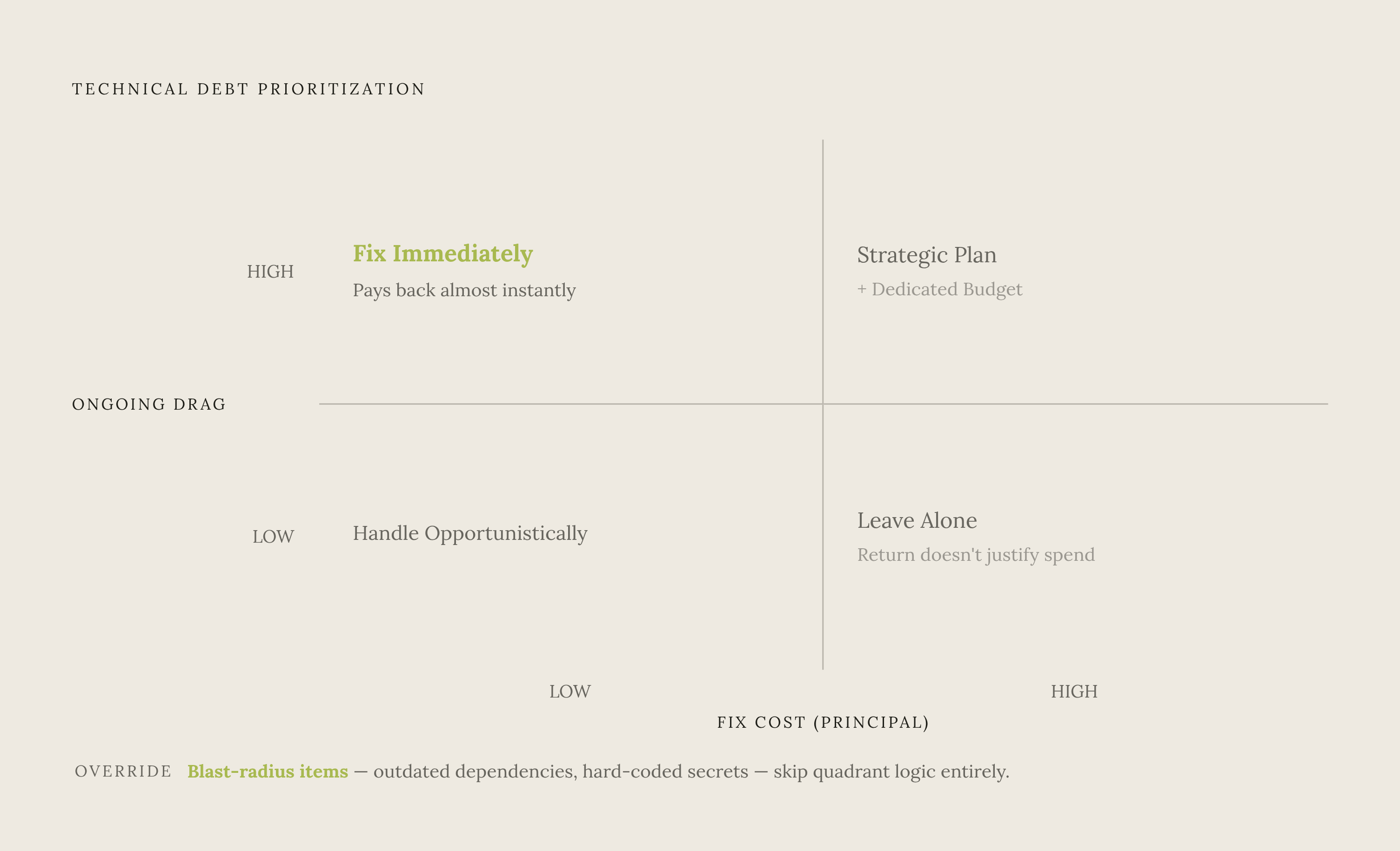
A prioritization matrix turns these numbers into something closer to a budget argument than an anecdote. Plot each piece of debt on two axes: fix cost, the principal, against ongoing drag, the interest it charges every sprint. Four quadrants fall out of that plot, and each one points to a different decision. That high-ongoing-cost, low-fix-cost debt pays back almost instantly, so it should get fixed immediately. Debt with high ongoing cost and high fix cost needs strategic planning and dedicated budget, since it's expensive either way and deserves a real plan rather than an ad hoc sprint. Debt with low ongoing cost and low fix cost can be handled opportunistically, whenever the team happens to be working in that part of the code anyway. Debt with low ongoing cost and high fix cost is often best left alone, since the return doesn't justify the spend.
A handful of factors shift where a given piece of debt lands on that matrix. Code churn raises the effective interest rate, since debt sitting in a file the team edits constantly costs more than the same debt sitting in a file nobody touches. And blast radius overrides all of it: outdated dependencies with known vulnerabilities, or hard-coded secrets sitting in a repository, demand action regardless of what the interest-rate math says, because the downside risk isn't measured in sprints, it's measured in incidents.
None of this works as well without a real baseline to measure from. IBM's brownfield modernization analysis names deterministic structural analysis, rules-based code analysis using tools like CAST Highlight and CAST Imaging, as the foundation that any credible modernization plan produces its accuracy from. That kind of analysis gives a team an accurate system baseline, full visibility into dependencies, and quality and security data with a level of fidelity that AI-assisted analysis alone can't reliably produce. The tool matters less than the discipline it represents. Measuring the system before committing to a remediation scope turns a debt assessment from a prelude into the actual decision document, the thing that tells a board or a funder whether a larger engagement is justified.
How to prioritize remediation so it recovers velocity without stalling product work
Remediation works best when it isn't treated as a separate "refactoring sprint" that pauses everything else. It works as a disciplined slice of capacity allocated alongside feature work, guided by the same prioritization matrix the previous section laid out. That allocation has to be protected, not scavenged from whatever's left over once the feature roadmap is satisfied. Teams that skip this allocation during a busy quarter tend to report the opposite of relief the following quarter: debt accumulates faster, not slower, because nothing ever interrupted the cycle that was building it. Scheduling the work, rather than hoping to find time for it, is what keeps the debt from quietly growing back.
The Strangler Fig pattern gives that allocation a concrete shape in practice. Start with the highest-cost module identified by the prioritization matrix. Wrap it. Route new behavior through the modern implementation while the legacy module keeps running underneath. Retire the old code piece by piece as traffic shifts over, rather than all at once. Done this way, no release ever has to wait on the rewrite, and users keep getting new features the whole time the underlying system is changing shape beneath them.
Quick wins deserve to come first, and not just for the obvious reason. Debt sitting in the high-ongoing-cost, low-fix-cost quadrant should get addressed in the very first sprint of any remediation effort, because the velocity improvement it produces is visible fast enough to build the internal trust a team needs before anyone funds the harder, more expensive work later. A win that appears within a sprint or two does more to secure the next round of budget than any slide deck.
Not every piece of debt deserves to be fixed, and that's a feature of good prioritization, not a failure of it. A disciplined decision to accept certain debt belongs alongside a disciplined decision to remediate other debt. The IBM Institute for Business Value frames the real goal as "debt by design": approaching each initiative with a clear view of the liabilities it will carry, and deliberately resolving only the debt that has to be resolved to make that specific initiative viable and profitable. The goal was never a debt-free codebase. Deliberate-and-prudent debt, a conscious trade-off made to hit a market window, documented with an explicit plan to repay it, is a legitimate tool, not a failure waiting to be discovered. The actual failure happens when that plan never gets scheduled and the trade-off quietly becomes permanent.
The test that separates the two is simple enough to ask about any piece of debt sitting in a backlog: was this shortcut taken on purpose, with a plan to come back to it, or has it just been sitting there because no one ever had to answer for it? The first is a decision. The second is the compounding interest charge this entire argument has been about from the start.