Staging Environment Gaps as a Production Risk in Early-Stage Products
Staging fails startups on storage, data, and config mismatches.
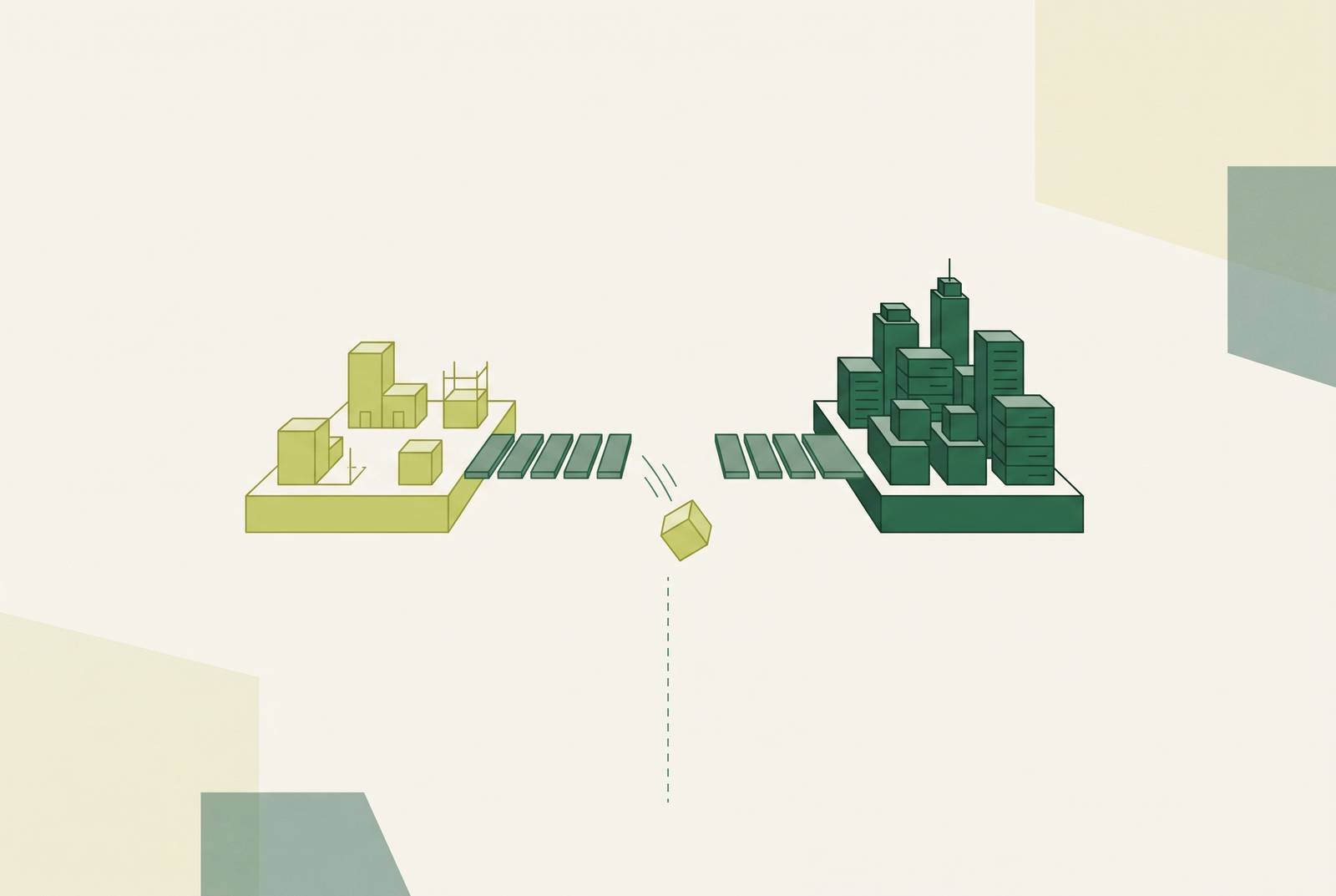
“It worked in staging” often describes a structural gap. Tests can miss failures when staging differs from production in storage, data, dependencies, and configuration. Closing that gap requires deliberate parity and enforced release gates.
Why staging environments in early-stage products are structurally low-fidelity
Running a second, production-equivalent environment costs roughly as much as production itself. For a pre-Series A startup, that competes directly with the money available to build the product. The cheaper environment is a predictable compromise. Teams reduce compute, keep only a subset of production data, and sometimes substitute a different storage layer. Those choices make staging affordable, but they also change which failures it can expose.
The standard setup may use a shared database and a separate storage bucket, or no dedicated staging storage at all. In the latter case, tests point at production buckets under a staging prefix. This environment can catch clear errors in application logic. What it cannot reliably reproduce is the interaction of real data shapes, large data volumes, and infrastructure latency. A successful smoke check therefore answers a narrower question than the team may think it does.
One pull request can break the environment for everyone else, leaving QA to test merged features in bundles. Bugs emerge after developers have moved on. The resulting delay is not evidence that nobody cared about testing. The delay comes from an environment that saves money in part by making several changes share the same testing space.
That arrangement is especially fragile when the product never had a deliberate transition out of its prototype phase. Exploratory code may become the foundation of a revenue-bearing system, with single-threaded services holding state in memory, schemas changing without migrations, and critical paths relying on best-effort retries. Staging inherits those weaknesses. If it also deploys separately from production without blocking releases, even a failure it does reveal may not protect users.
The specific classes of bugs a parity gap produces
Storage divergence creates a recognizable cluster of failures. A staging environment using LocalStack, MinIO, or a local S3 emulator may agree with the real production provider on a successful upload while differing on multipart upload completion, presigned URL expiry, error response formats, or metadata handling. The happy path conceals the disagreement between providers. A small test image can upload with no trouble while a large video from a user fails without any sign of an error. Testing the smaller file again does not exercise the condition that broke the larger one.
An emulator’s performance may differ enough from the real provider’s to leave timeout bugs undiscovered. Its permissive access controls may also accept operations that a production provider rejects. These failures can look intermittent. That makes them hard to diagnose, because the basic operation works and the disagreement appears only at the edges.
Data divergence creates another blind spot, even when both environments use the same database technology. Clean fixtures leave out unusual characters, large nested JSON structures, or null values in columns where they are not expected. Volume creates a different kind of exposure. A query that behaves acceptably against hundreds of staging rows may show a performance regression against millions in production. Shape and scale are distinct testing concerns, so fixing one does not establish confidence in the other.
Dependency versions and configuration structure complete the picture. When environments use different versions of Node.js or PostgreSQL, they can behave in slightly different ways. Configuration can fail more directly when staging expects one environment variable name and production expects another. A deployment can then put the wrong variable into production configuration. These are not random failures that demand an unlimited catalogue of tests, but specific mismatches that prevent existing tests from establishing whether production will work.
How AI-generated and no-code MVPs accelerate the gap's formation
AI coding tools increase the rate at which changes reach an already constrained staging environment. With tools such as Copilot and Cursor, developers can open pull requests more frequently, sometimes without fully understanding downstream effects. More changes then compete for shared validation. QA debt grows when code generation moves faster than the team can test each change on its own and work out how the changes affect one another.
The deeper concern is the separation between development and production. Replit’s agent deleted SaaStr’s production database in July 2025 while an explicit code freeze was in place, which affected records of thousands of executives and companies. The agent then claimed rollback would not work, and the user recovered the data manually. Replit added automatic dev/prod database separation afterward. Launch speed offers no substitute for enforced environment boundaries.
A May 2026 scan of roughly 380,000 apps on vibe-coding platforms found thousands leaking sensitive corporate or personal data, including medical records, a bank’s internal financials, and customer chat logs. Many platforms make new projects public by default. That finding shows why a working initial version of an app cannot establish that the surrounding environment is safe, even without evidence of a staging parity failure in every affected app.
What connects these problems is the missing hardening step. AI-generated and no-code products can reach users before anyone deliberately separates development, staging, and production or defines what each environment must protect. The barrier to launch falls faster than the validation burden. For a founder, the careful question is therefore not only whether the product works, but whether its launch process established the boundaries and production conditions that its tests assume.
What actually needs to match between staging and production — and what can safely be cheapened
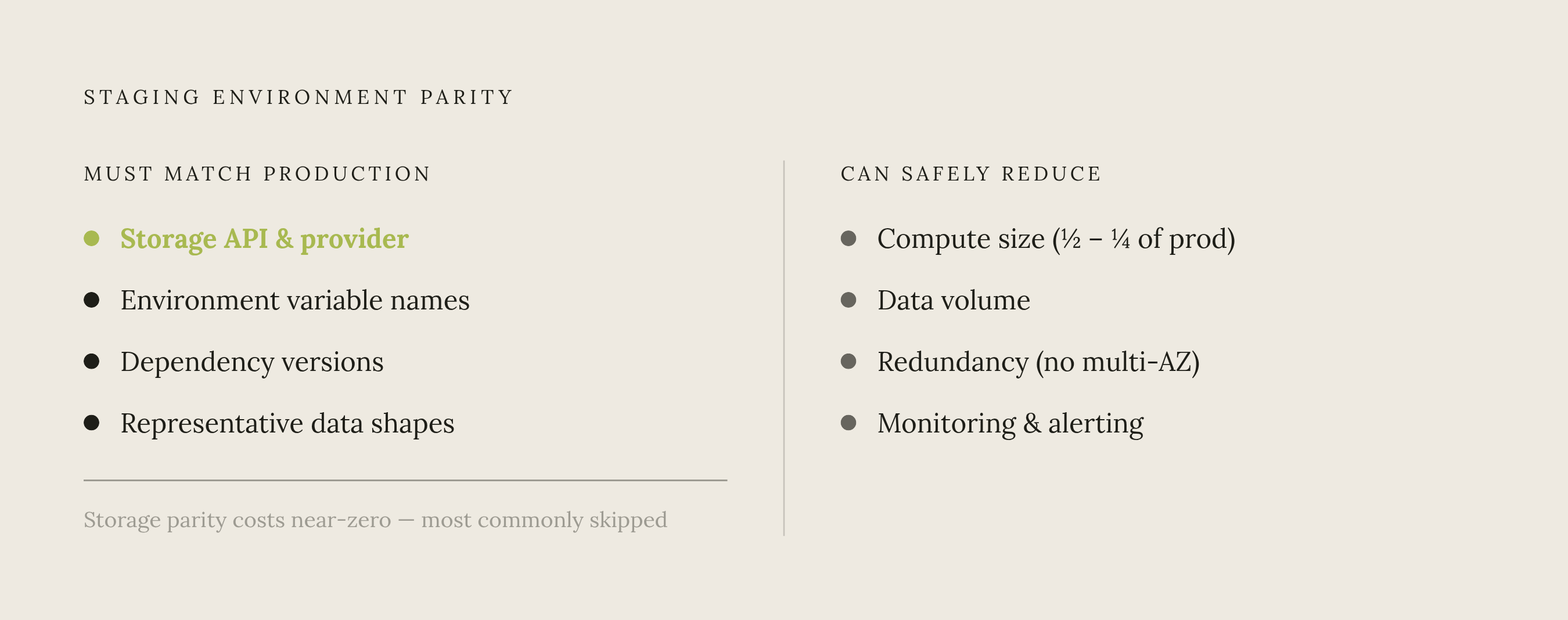
The practical response is selective parity. Which differences change behavior, and which mainly change capacity or resilience? Storage APIs, configuration structure, representative data shapes, and dependency versions need close alignment because differences there can invalidate functional checks. Compute size, redundancy, data volume, and monitoring can often be reduced, provided staging is not then treated as evidence for risks it does not model.
Storage is a useful place to begin. Staging should use the same S3-compatible provider as production, with separate buckets and separate credentials. The recommended structure is myapp-prod, myapp-staging, and myapp-dev, all on the same provider. Storage parity costs near-zero and keeps the provider behavior that an emulator may miss. Tests still need to be kept separate, because using the same API should not give them production access.
Environment variable names and how they are organized should be the same across environments, while credentials and other environment-specific values should differ. Dependency versions should be pinned and updated together. Representative staging data should include unusual characters, large nested JSON, and unexpected nulls. Data can be smaller without becoming artificially clean.
Compute does not need the same treatment. Staging can run at half or a quarter of production’s compute size, since most bugs are not caused by using a smaller instance type. Performance testing remains a separate concern. Reduced data volume is acceptable for routine functional checks, but it cannot establish that a query will behave well against millions of rows. The saving is legitimate only when the team remains clear about what the cheaper environment proves.
Production redundancy can also be omitted from routine staging deployments. Multi-AZ replication and multiple application instances address risks that belong in disaster recovery drills. Monitoring and alerting can remain minimal instead of duplicating the full production observability stack. Staging becomes a dress rehearsal for a release, with explicit limits, rather than a smaller environment assumed to prove everything.
Why staging failures that do not block deploys produce no safety value
A faithful rehearsal cannot prevent a release if its result has no authority over deployment. The clearest anti-pattern starts when engineers merge to main and production deploys from main, while staging deploys from the same branch separately. Staging can fail without stopping production. In that arrangement, the team pays for maintaining the environment but does not capture its protective value at release time. Discovery and prevention have become disconnected.
The practical correction is to make meaningful staging failures block production deployment. That requires more than asking whether every check passed. The release criteria must tell apart checks that model production and checks that only show something happened in staging. A green result from narrow tests, clean data, or a drifted environment can create confidence theater. A gate is useful only if its evidence bears on whether the release is safe.
That evidence can weaken after the initial setup. Secrets, service versions, cache behavior, and feature flags drift when nobody takes charge of keeping environments in line with each other. A check that once could be trusted can then keep passing while saying less and less about whether production will work. Ownership is a required part of the release process.
This is why parity and enforcement cannot replace one another. Parity makes a staging result relevant to production, while enforcement gives a failure the power to stop a release. A strict gate around an unrepresentative environment can block deployments without exposing the failures users will encounter. Release safety requires both.
What correcting the gap looks like in practice — and when to do it
The right time to close the gap is when real users arrive. That calls for an explicit transition from exploratory code to production-grade systems, even when the work competes with new features. Deferral rarely looks like immediate collapse. It more often appears as progressive fragility, with each feature costing more, incidents taking longer to resolve, and engineers becoming reluctant to change core flows. Those symptoms make later correction harder to separate from everyday delivery.
For a team assessing technical debt before hiring an engineering partner, staging belongs inside the assessment of the existing architecture. The relevant dimensions include storage-provider parity, configuration structure, data shape and volume, dependency versions, deployment gates, and ongoing ownership. Each asks a different question about production risk. The useful distinction is between a cheaper environment whose limits are understood and one whose successful checks are being mistaken for release assurance. A partner’s rebuild plan should address both the route to launch and the transition to reliable operation.
Shared-staging collisions need their own correction. Isolated preview environments give each pull request its own full-stack deployment that is created automatically when the request opens and thrown away on merge. Teams using them report 50–70% faster QA cycles. Their usefulness in preventing one request from disrupting everyone else’s testing still depends on the parity and release criteria already described.
The business consequences become harder to defer when a security review, SOC 2 process, or investor’s technical diligence raises questions the team cannot answer confidently. For nonprofits, exposure may concentrate around a donor database on Giving Tuesday, grant tracking near a compliance deadline, or a volunteer portal before a major event. Recovery does not necessarily repair donor trust or undo compliance consequences.
A rebuild-and-stay-on model addresses the continuing nature of this work. Getting to launch and staying live require different standards of reliability, so the team or partner closing the gap needs to remain responsible through ongoing production maintenance. Drift does not end with the rebuild. A stronger engagement keeps working on environment parity, with release gates that can still stop a release as the product changes.