Hiring an Engineering Studio to Triage an AI-Built Codebase Before It Fails at Scale
A structured audit finds design flaws AI review misses before they cause production failures.
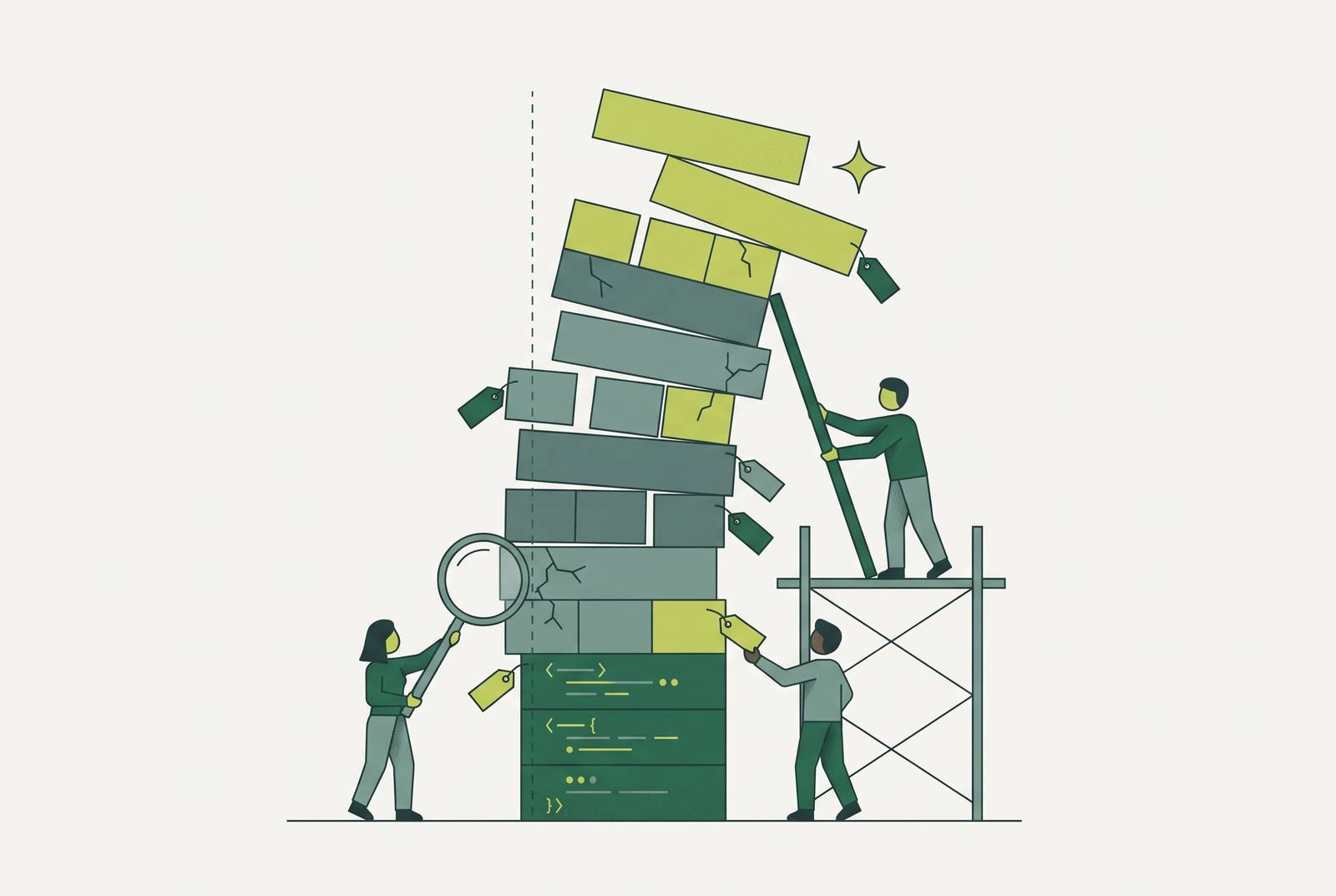
For an AI-built or freelancer-built MVP, hire an engineering studio that audits before changing code, knows when to use targeted hardening and when to use deeper re-engineering, and stays through implementation. Triage is a structured way to find the gap between code that passes review and code that holds under real users, then close the dangerous parts before growth makes them harder to fix.
Why AI-built codebases pass review and break in production
A pull request can show clean, readable code without showing how that code behaves under production conditions. Consistent style, familiar patterns, and correct syntax are useful signals, but they do not reveal transient network states, concurrent race conditions, or changes to shared data across tenants. Those are different kinds of evidence. When review treats readability as proof of operational safety, structural errors can remain hidden until customer traffic exposes them.
New Relic’s 2026 State of AI Coding report identifies this disconnect between static review and runtime behavior. The report finds that a majority of surveyed technology leaders say AI generates or significantly refactors more than half of their organizations’ weekly code output. That makes the limits of review an operational concern. More machine-generated output does not give reviewers more visibility into the conditions under which it will run.
A developer can carefully review a change without seeing what happens when services disagree about a schema or multiple users change related records. Some hidden issues take time to cause a failure. Some make later changes harder. A codebase can look healthy at launch while becoming progressively more difficult to maintain.
What functional correctness scores miss about design quality
If review cannot establish production readiness, can a strong test score do it? The Wuhan/RMIT/Massey/Central China Normal/Nanjing empirical study generated large-scale projects using Cursor within a structured, human-in-the-loop framework. Those conditions were more rigorous than a typical founder’s MVP workflow, and the projects achieved an average functional correctness score of 91%. Yet two independent static analysis tools found thousands of distinct design issues in the same projects.
The study’s most prevalent categories included Code Duplication, high Code Complexity, Large Methods, Framework Best-Practice Violations, Exception-Handling Issues, and Accessibility Issues. These are not interchangeable warnings. Duplication is logic that is repeated, while large methods and high complexity make it harder to understand and change how the code behaves. Exception handling concerns what happens outside the successful path. Accessibility issues also show why a feature that works is not enough to prove its quality.
These findings point to design principles such as Single Responsibility, Separation of Concerns, and avoiding duplicated logic. A passing test suite does not establish that those principles hold. Their absence becomes more costly when engineers add features, newcomers learn the system, or concurrent users put pressure on its assumptions. The study therefore calls for careful review by experienced developers, even when generated projects do what they were asked to do. For triage, the question is not merely whether a feature works, but whether its design allows the product to evolve safely.
How design debt compounds once real users arrive
As more features are added, repeated logic leaves more places that may need to change together. As the team grows, complicated modules take more effort to explain. More users also put more pressure on assumptions that were good enough for a small demo. These changes increase the cost of leaving structural weaknesses unresolved.
The large-scale empirical study Debt Behind the AI Boom found that 22.7% of the AI-introduced issues it tracked were still there at the latest repository revision. Meanwhile, the New Relic report describes senior DevOps and SRE engineers spending up to one-third of their active workweek triaging, debugging, and refactoring machine-generated failures. It calls this the “AI code janitor” bottleneck. Work intended to scale the product becomes work required to keep it functioning.
Comprehension debt makes that shift harder to reverse. Brett Wheeler’s research on authorship-based knowledge metrics argues that a human’s name on an AI-generated commit no longer establishes that the human understands it. The same attribution can represent full understanding, partial understanding, or none at all. When a second engineer or contractor must change that module, the missing knowledge becomes a practical obstacle to locating and safely resolving problems. The time to step in is therefore before growing demand turns that lack of understanding into delays and incidents.
What specifically breaks in an AI-built MVP that a triage engagement must find
AI tools optimize for “it runs,” leaving a gap between that and “it operates. The distinction appears in the boundaries around working features, including tenant isolation, credentials, monitoring, deployment, and recovery. A demo that works may never put any of those boundaries to a serious test. A triage engagement must test those boundaries because serving customers safely depends on them as well as on a main workflow that completes.
Multi-tenancy is a clear example of that difference. Shared tables filtered only by application logic lack tenant separation enforced at the data layer, creating the risk that customers can reach one another’s data. Credentials embedded in code cause another problem at those boundaries when the application moves between environments. They create security exposure and operational fragility even if the feature using those credentials works correctly.
Other gaps make failures harder to detect or recover from. Without error monitoring, distributed tracing, or alerting, a user complaint may be the first indication that something has broken. Unindexed queries can perform acceptably on development data and degrade severely as records accumulate. Without a deployment pipeline, there is no safe way to get updates into production. Without backup-and-restore validation, recovery from data loss remains untested.
A large method or repeated logic may not trigger an incident by itself, but it can make the affected behavior harder to isolate and repair. Exception-Handling Issues can further complicate resolution when a request leaves the successful path. The failure profile is therefore broader than insecure code or slow queries.
What a structured triage engagement actually involves, step by step
For a founder hiring a studio, the engagement should begin as a scoped, sequenced audit with a prioritized remediation plan as its output. The first step is inventory and architecture mapping, before any code changes. The studio needs to establish what the application actually does and how its parts relate, rather than relying on what the original developer intended. That distinction is especially important when generated modules are not fully understood. The map gives later findings a place in the system.
Static analysis then establishes a tool-supported baseline. Automated scanning surfaces the categories and density of design issues, giving reviewers something firmer than an impression that the code looks untidy. The project-generation study used CodeScene, which found 1,305 design issues across nine categories, and SonarQube. Such results help locate areas needing investigation. They do not, by themselves, establish which issue threatens the next customer or growth milestone.
Business logic testing addresses what that baseline cannot settle. The New Relic report identifies silent database degradation, transactional record duplication, and unhandled null states among data-integrity failures. A human engineer must trace the business logic paths that handle those records and states rather than assume that automated checks show what the application is meant to do. Can the system preserve the records and state on which the product depends when those paths do not go as expected?
Engineers test permissions, authorization logic, and API security by hand because a scanner’s ability to recognize vulnerability patterns does not establish that the multi-tenancy architecture is sound. A dependency audit examines another source of exposure, including outdated or vulnerable dependencies, licensing inclusions, and policy deviations. These checks address different risks. Passing one does not substitute for passing the other.
Senior review turns those findings into decisions. The output should separate dangerous correctness and security debt from lower-priority maintainability problems, with remediation tied to the product’s next growth milestone. It should also identify who understands each important part of the system and where that knowledge is missing or concentrated. A commit history cannot answer that question reliably. The engagement ends with a bounded plan for action.
How do you tell whether your MVP needs hardening or deeper re-engineering?
Fixing every issue immediately would be expensive and counterproductive. The study of real-world commits found that code smells make up 89.3% of AI-introduced issues. Most findings in that study were therefore maintainability problems. They deserve attention over time, but their presence alone does not establish an imminent production incident. A studio earns trust by making that distinction explicit.
The New Relic report names four production failure categories that provide a useful risk framework, including integration failures, compliance and governance issues, data-integrity problems, and newly introduced security vulnerabilities. Findings in these categories call for immediate attention, while duplication and large methods may be deferred. Priority depends on the consequence. A long report with no reasoning about urgency leaves the founder with the original decision still unresolved.
Targeted hardening fits a sound architecture with isolated operational gaps. Missing observability, absent CI/CD, embedded credentials, and unindexed queries can be addressed without replacing the core data model or business logic layer. Deeper re-engineering fits a different situation. If tenant separation, authorization, or the data layer rests on an incorrect assumption, patching visible symptoms will not repair the foundation.
The practical test is whether a fix can be isolated, tested, and deployed without requiring the team to understand the whole system. If it can, targeted hardening is appropriate. If it cannot, comprehension debt is the first problem to solve before judging the scope of deeper changes. A written, risk-stratified backlog should explain both the chosen work and what is deferred. A studio that stays through implementation can address lower-priority debt in cadence, avoiding the cost of forcing everything into one sprint.
When to initiate a triage engagement, and what happens if you wait
The triage window opens when the product moves from validating demand to operating under real users. A first paying customer is one concrete trigger. Others include a newcomer trying to work in the codebase, a feature request touching a module nobody fully understands, or a security or compliance conversation with a potential enterprise customer. These indicate that the standard the MVP must meet is changing.
Waiting past those triggers concentrates the work. An authorization model that is straightforward to re-architect with an early user base can later require a live-system migration with customer data at risk. At that point, remediation competes with both product development and the demands of keeping the service running. The cost is no longer just a future maintenance burden. It includes engineering capacity already diverted from growth.
For a founder choosing a partner, the criteria follow from that difference. Where rebuilding is necessary, the relationship should extend beyond establishing sound foundations to maintaining them as the product grows. Initiating triage remains a decision the founder can make deliberately, before users make the timing unavoidable.