When Keeping the MVP Code Is the Right Call and When It Is Not
Audit your MVP's coupling and data model to decide whether fixing it costs less than rebuilding.
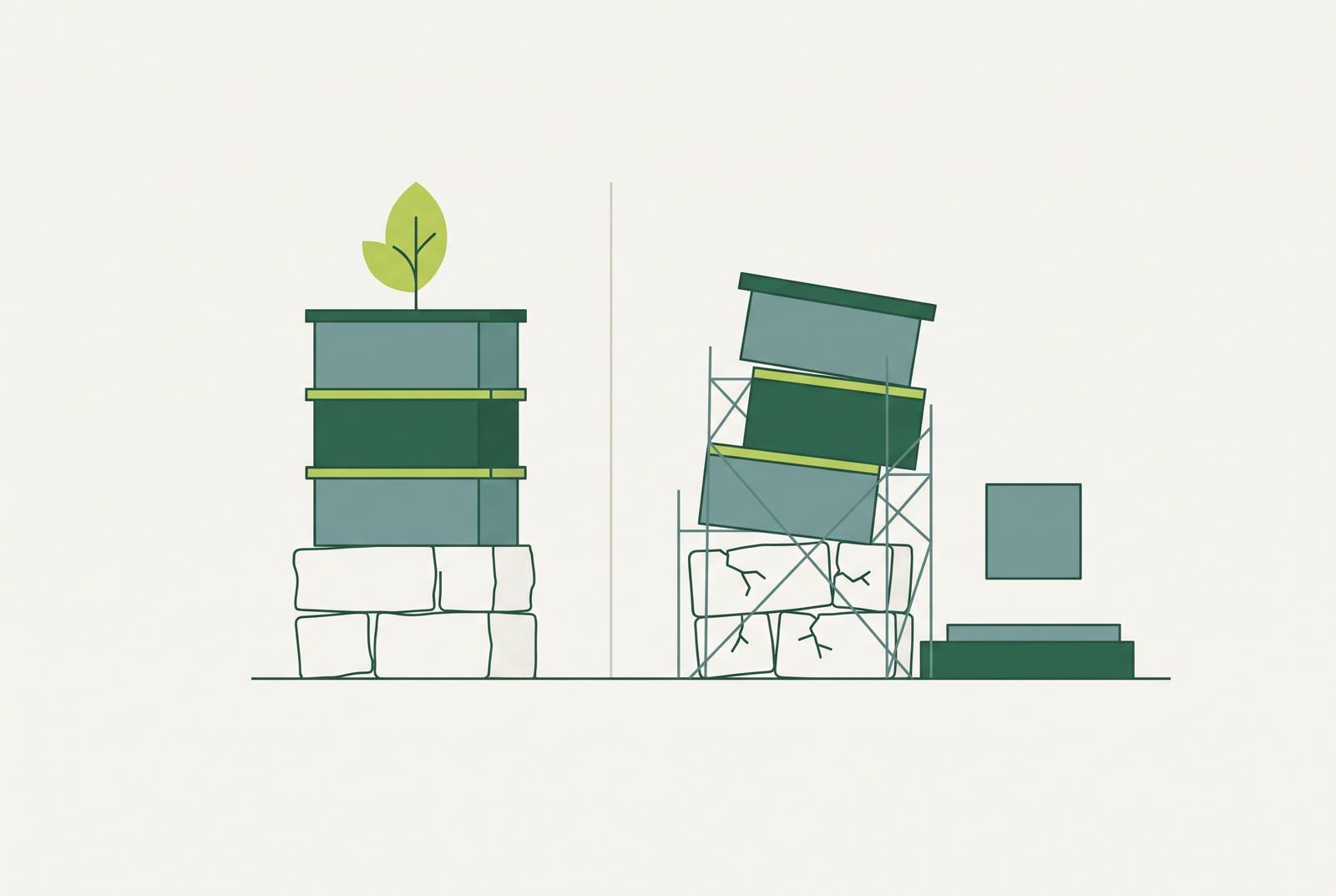
Keeping an MVP codebase is the right call when its shortcuts are known, bounded, and safe to repay incrementally. Rebuilding becomes defensible when hidden coupling and a weak data model make growth more expensive than a clean foundation would. For founders taking over AI-generated or freelancer-built software, the deciding evidence should come from an audit.
Why the "keep vs. rebuild" question only matters after the MVP has done its job
An MVP is a tool for a particular stage. Its code may have been right for testing an idea without being right for the business that emerges. Treating it as disposable by default wastes useful work, while treating it as production-ready by default leaves launch-day compromises unexamined. The question changes when users return without being chased, the product generates revenue, and the roadmap depends on concurrency, data integrity, or deeper integrations.
That is the moment to revisit those compromises deliberately. Before validation, a rebuild can consume capital on architecture nobody needs yet. After growth has exposed the weak points, the same work competes with customer demands and an expanding roadmap. Neither timing error says much about the original MVP.
The difference between debt you chose and debt you didn't notice
Good debt is an intentional shortcut with a known payback plan. Manual admin work can stand in for automation, a simplified data model can leave room for usage patterns to emerge, and basic error handling can improve after validation. The limit is explicit. Someone knows what was deferred and owns the plan to address it.
Bad debt is a structural flaw nobody recognized or tracked. Tightly coupled logic, absent environment separation, and no database migration strategy belong here because they make ordinary changes dangerous in ways the team has not planned for. The distinction is not visual polish. Did the person who wrote the code know it was a shortcut, and did they leave a plan? An undocumented compromise is accidental debt because the next engineer cannot manage an obligation they cannot see.
AI-assisted and vibe-coded MVPs deserve particular attention because the tools optimize for immediate results. Duplicate logic, inconsistent naming, and missing tests can therefore form patterns across the system. A working demo does not resolve that uncertainty. For a freelancer-built MVP, the same test concerns the handoff, including whether decisions and deferred work are visible to whoever takes over.
One class of accidental debt that cannot wait — security and environment basics
Exposed credentials, permissive database access, and absent environment separation are active security or reliability risks that need attention before fundraising. An exposed API key can become an incident within hours of discovery. Removing it from the current code does not remove it from git history. Exposed credentials need rotation and history scrubbing with tools such as BFG or git-filter-repo.
A row-level security rule using USING (true) without a role restriction defaults to all roles, including anonymous access, so anyone with the URL can read that data. AI tools may write such rules to make a demo work. Testing against production data without staging also turns every deployment into a live test on paying users. These risks need fixing whether the eventual answer is keep, refactor, or rebuild.
How do you assess whether to refactor or rewrite your MVP?
The audit is triage. Its purpose is to distinguish local, repairable problems from defects that run through the system. A founder can work through the questions with the person assessing the code and record each serious warning. Keep the answers concrete and roughly countable. Where a question asks whether the system can do something safely, a “no” is the warning.
Start with coupling, because it decides whether a repair can stay in one part of the system. Does changing one feature reliably break something unrelated? Does a single unwieldy file or component do work that should be separated? Can a new developer add a small feature in under two hours without guidance? These questions test changeability, and a component doing too many jobs is a decomposition problem.
Next, test the data model’s integrity and explainability. Are User, Profile, and Account duplicated versions of roughly the same entity, with inconsistent names or unclear field ownership? Can the data flow be explained in one whiteboard session? A weak schema makes it harder to work out where each addition belongs. For example, team collaboration may require changes across many more tables than a clean model would need, turning a product request into a wider repair.
Then ask whether changes have a safety net. Is test coverage zero or near zero? Are staging, smoke tests on core user flows, or production error monitoring missing? Do releases feel risky enough that deployments get delayed? Fear of deploying is a useful signal, especially when nobody can show how the most important workflows will be checked after a change.
Finally, test portability and the overall design. Can the app move to standard hosting without rewriting more than a small fraction of it? Can someone draw the frontend, backend, database, and integrations in five minutes? An answer about “many files” does not explain an architecture. Record whether the team knowingly chose to depend on its hosting, since being able to export code is different from having a system that can move to another host.
The thresholds at which specific types of debt start hurting the business
Some problems hurt as soon as the first paying customers arrive, while others cost more as the team builds more features and has more people working together. Security and unsafe deployments offer no grace period. Naming inconsistencies and poor organization become more visible once a meaningful customer base needs steady improvements. Onboarding that takes weeks instead of days is one way those defects consume the team’s time.
Adding another engineer can expose a different threshold. Knowledge that lived in one person’s head must now transfer, and ad-hoc processes leave more opportunities for debt to accumulate without an owner. More users are not the only trigger. Working together can cost a team more time before the number of customers puts a strain on the architecture. Urgency therefore depends on the next operating change as well as the current customer count.
The time it takes to ship features often gives the clearest early warning. A workflow that looks small takes far longer than expected because nobody trusts the code, the schema is messy, and each fix adds another edge case. Costs rise while progress slows. A Series A process can expose the same underlying weakness through technical due diligence, even if customers have not noticed it. The decision therefore needs both a count of serious findings and a view of what the business will ask the system to do next.
The decision logic — when to keep and address incrementally, when to rebuild
Begin with the branch where changes remain isolated. If the audit produces three or fewer serious signals, the urgent security and environment problems are fixed, and deferred work has a known payback plan, keeping the code is defensible. A focused cleanup sprint may restore safe delivery without stopping the roadmap. The work should target the fraction of files causing most problems. Manual processes or simplified models do not justify replacing an otherwise workable system.
If the defects exceed that scope, ask whether they are concentrated in specific subsystems. Can the root cause be fixed within a bounded window without a full feature freeze? If so, surgical refactoring is the next branch. It preserves the parts that work while repairing those that obstruct growth. This is not a lesser version of rebuilding, but a response to evidence that the damage is localized.
Full rewrites deserve caution because they take longer than expected, discard knowledge embedded in existing code, and can introduce different problems. Seven or more serious audit signals strengthen the rebuild case when coupling and data-model defects are pervasive. The number alone is not a verdict. An architecture designed for one user persona may now need enterprise use, multi-tenancy, or concurrency that its original schema cannot support. When incremental repair approaches or exceeds the cost of a clean foundation, rebuilding becomes the more defensible branch.
Between those thresholds, the team needs to look more closely at where the problems are before choosing what to do. For a justified rebuild, the practical approach is a bounded feature freeze and a new design around what the product has become. Service boundaries, database design, and deployment paths need work before the team polishes how the product looks. Ownership of the codebase and infrastructure should also be part of the replacement, rather than another dependence accepted without a plan.
How the keep-vs-rebuild question plays out differently for nonprofit and no-code-first teams
For a no-code-first team, the audit shifts from code to the product’s operating constraints. Nonprofits often have limited budgets, staff in multiple roles, and no in-house engineers, making no-code a sound first choice. The debt accumulates through vendor dependence, workflow restrictions, and integration overhead. The mechanism differs, but the burden still compounds. Eventually, manual workarounds can let the tool dictate the roadmap.
Airtable makes that tradeoff concrete for a small team. The team still has to connect payment processors, build donor databases, and manage several tools. Keeping it can be reasonable when workflows are simple and the setup is not constraining the mission. Migration becomes the equivalent of rebuilding when subscriptions, weekly workaround hours, and integration complexity approach the cost of a purpose-built replacement.
Migration options should be compared by the job they serve. Baserow, NocoDB, and Grist offer open-source or source-available, self-hosted paths for data control and cost efficiency at scale. Baserow offers relational databases, self-hosting, and compliance coverage including GDPR, HIPAA, and SOC 2. Fundraising has a different fit. Zeffy is free with built-in donations, CRM, and events and requires no technical setup, while Notion and Coda suit knowledge management and lightweight databases, and ClickUp and Monday.com fit structured execution.
There is also a path beyond keeping a tool or buying its replacement. A partner-build lets an outside engineering firm design software the organization owns, with a smaller internal team or none. Time to first value is typically measured in months. The organization keeps code ownership while the partner takes on talent risk. For a mission-specific workflow, that makes ownership possible without first assembling an engineering department.
What to do in the window between the audit decision and the rebuild start
A rebuild decision does not suspend the current product. The immediate task is stabilization, with exposed secrets rotated, environments separated, and error monitoring active. Before changing the structure, add smoke tests for the most important user flows. Those tests make iteration and refactoring safer. A bounded freeze on new features then prevents the team from extending the same foundation while planning its replacement.
After stabilization, debt work needs an operating rhythm. Otherwise, the right decision can still fail because “later” keeps losing to product requests. Shopify’s documented “25 Percent Rule” allocates a fixed share of engineering capacity to engineering-controlled debt paydown across daily, weekly, and monthly timeframes.
For a founder responsible for go-to-market, ongoing technical ownership also needs a home. The partner criteria follow from the audit, including the ability to assess coupling and data integrity, choose targeted repair where possible, rebuild where necessary, and stay through growth. A handoff alone does not solve recurring prioritization. The partner-first, hire-second path lets a team ship the rebuilt product, use it to win customers and raise the next round, then hire engineers into a clean codebase.